

In partnership with

How High Are Art Prices Today? The Latest from Spring Auctions…

Let’s check out the latest auction highlights…
$85,800,000 for Rothko
$98,385,000 for a ANOTHER Rothko
$107,585,000 for a Brancusi sculpture
$181,200,000 for a Pollock
Sounds crazy, but those masterpieces were once-in-a-lifetime opportunities for the ultra-rich buyers.
Postwar contemporary art’s scarcity is largely what’s driven price appreciation that’s comparable to the S&P over the last thirty years.*
This trend has made art investing out of reach for most people.
But since 2017, Masterworks has taken a data-driven approach to investing in art, making it accessible to individual investors.
Masterworks members have the opportunity to invest in shares of artworks by legendary artists like Rothko, Basquiat, and Warhol. When a piece sells, they get a share of the proceeds.
Over $1.2 billion has been deployed across over 500+ artworks.
And over the last six months, seven of those have sold. Overall, 29 exits to-date have delivered net annualized returns like 16.5%, 17.6% and 17.8% on works held longer than one year, not including those unsold.
To see Masterworks track record of sold works and inquire for membership, my subscribers can use this unique link.
*According to Masterworks data. Investing involves risk. Past performance is not indicative of future returns. See important Reg A disclosures at masterworks.com/cd.
Trump Cannot Primary The Price Tag
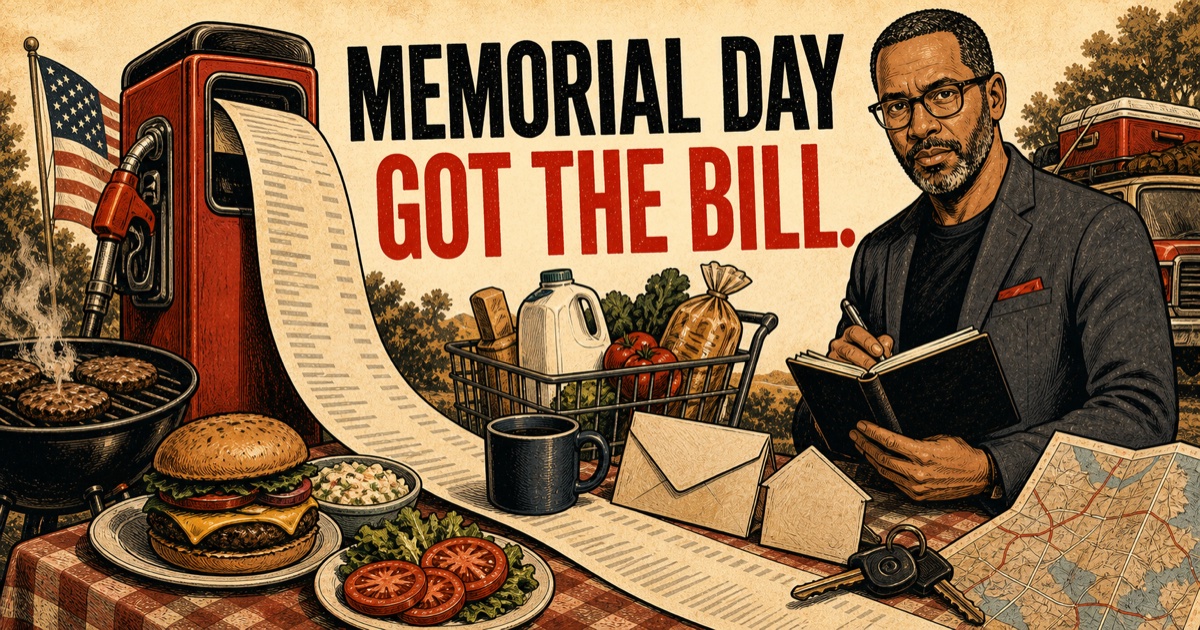
Memorial Day got the bill: gas, groceries, power, rent, wages, tariffs, and the price hike presidency.
The cold open
The president can pick a fight with a judge. He can threaten a senator. He can send a tariff order into the world with a Sharpie and a camera angle.
What he cannot do is bully the price tag.
That is the Memorial Day story. Not vibes. Not cable-news feelings. Not a focus-group complaint. The official basket is higher. The pump is higher. The power bill is higher. The cookout is higher. And the paycheck, once prices are counted, is not keeping up.
The price tag is the receipt.
The confession
I understand why people want the economy to be a scoreboard.
One number. One president. One chant. One clean explanation you can throw across a dinner table before somebody asks who brought the potato salad.
But price pain is not a scoreboard. It is a map. It moves through the pump, the truck, the shelf, the utility bill, the rent notice, the plane ticket, the import dock, and then finally into the ordinary American sentence that decides elections:
Why does everything cost more?
That sentence is not ideology. It is muscle memory. You hear it when a family decides whether the Memorial Day trip is still worth it. You hear it when the grocery cart is not full but the receipt looks finished.
And in the first full spring of Trump's second term, the receipts do not say prices came down.
They say the bill climbed.
The machine
Start with the official basket.
The Bureau of Labor Statistics says the Consumer Price Index rose 3.8 percent over the 12 months ending in April 2026. The same index sat at 317.671 in January 2025. By April 2026, it was 333.020.
That is roughly a 4.8 percent climb from January 2025 to April 2026.
Then look at the parts people feel: gasoline up 28.4 percent from April 2025 to April 2026, energy up 17.9 percent, electricity up 6.1 percent, airline fares up 20.7 percent, beef and veal up 14.8 percent, food up 3.2 percent.
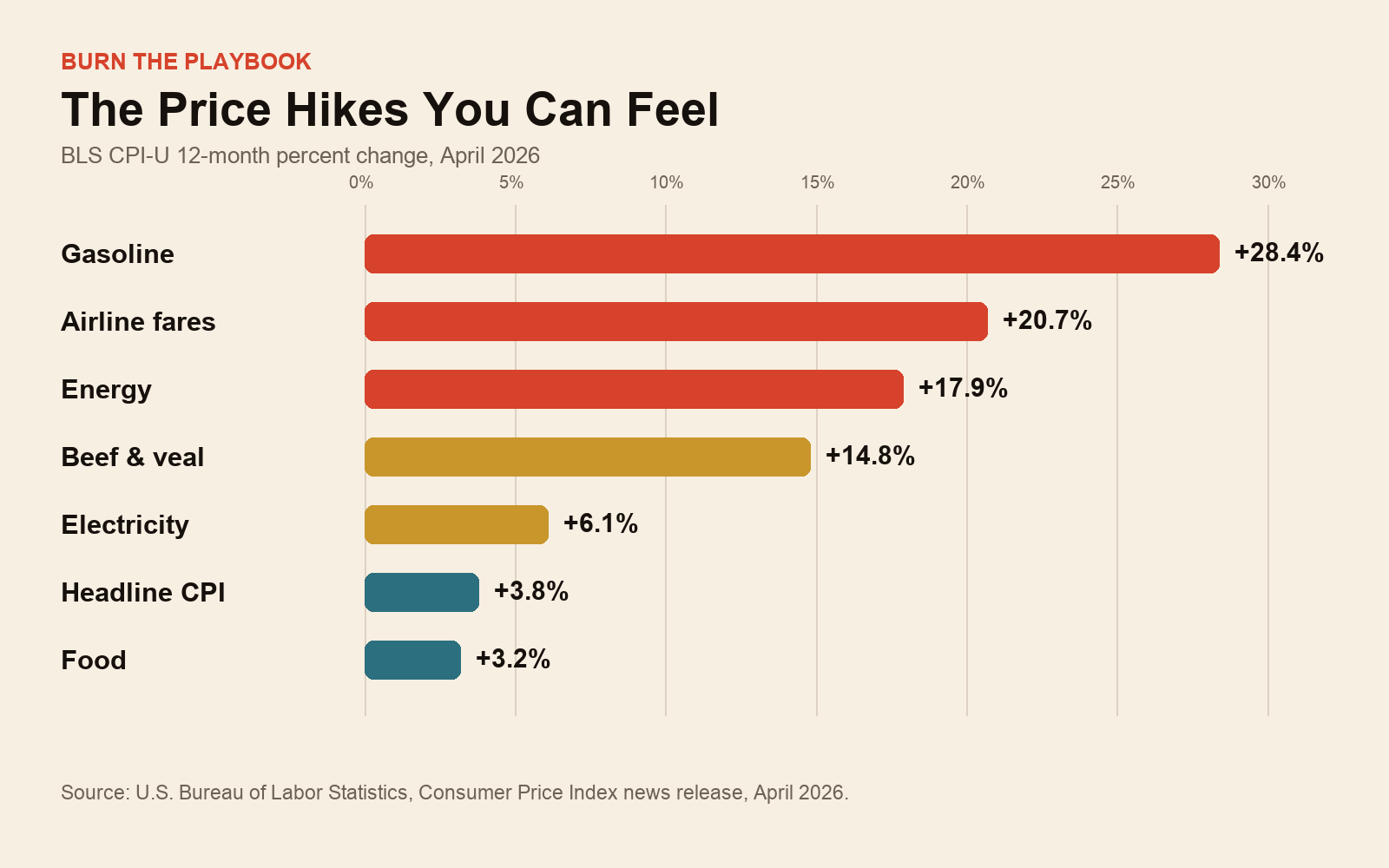
That is not abstract inflation. That is the Memorial Day weekend: the drive, the grill, the lights, the flight, the cooler, the hotel, the delivery truck.
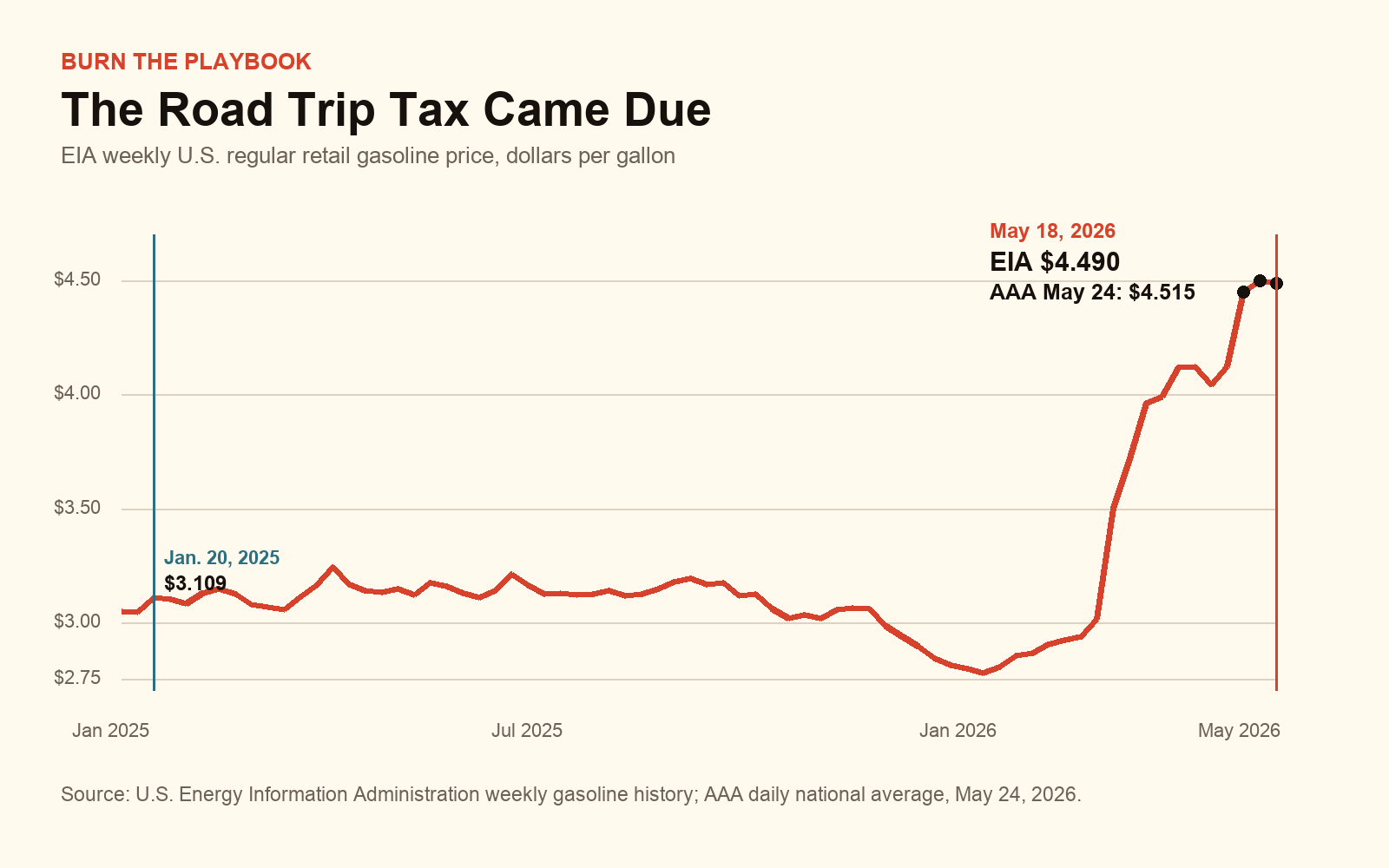
And the gas chart is brutal because it has a date on it.
EIA's weekly regular gasoline series put the national average at $3.109 on January 20, 2025. For the week of May 18, 2026, it was $4.490. AAA showed $4.515 on May 24, 2026.
The receipt
The receipt is not just price levels. It is buying power.
BLS says real average hourly earnings fell 0.5 percent from March to April 2026 and fell 0.3 percent from April 2025 to April 2026.
That means a worker can get a raise on paper and still lose ground at the register.
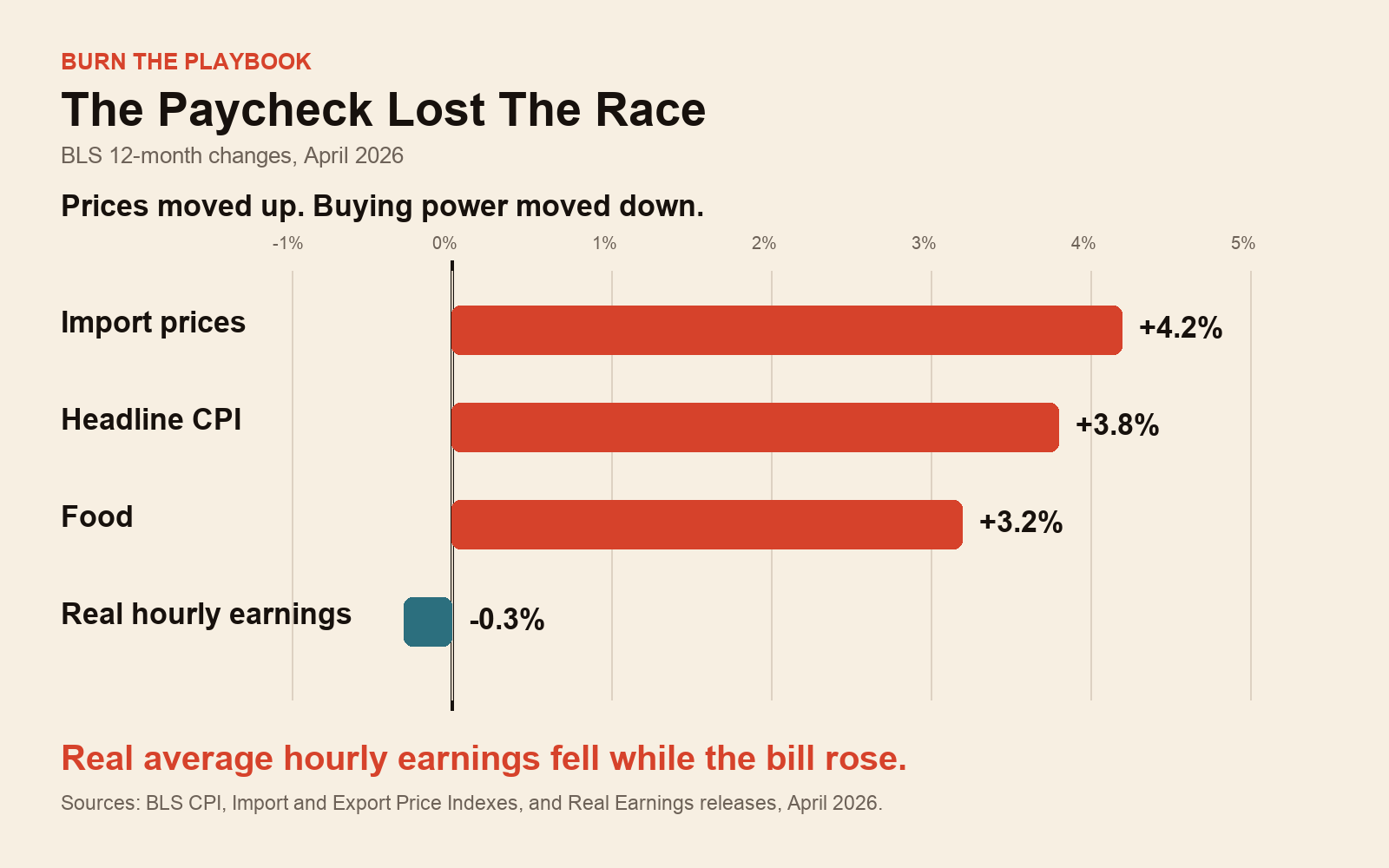
Then there is the tariff pipeline. BLS says import prices rose 1.9 percent in April 2026 and 4.2 percent over the year. The White House, meanwhile, announced broad new tariffs in 2025, including the February Canada/Mexico/China tariffs and the April reciprocal tariff order.
That is what a tariff is in real life. A tariff is not a macho sentence at a rally. It is a tax with a shipping label.
The translation
Here is the grocery-store version.
When the government adds border costs, somebody has to eat them. Sometimes the importer eats a piece. Sometimes the retailer eats a piece. Often the family eats the rest.
When energy shocks hit, the pain does not stay in oil markets. It hits the pump. It hits diesel. Diesel hits freight. Freight hits food. Food hits the cart. The cart hits the card.
When real wages fall, a worker can do the right thing, clock in, get paid, and still feel poorer by Friday.
That is the machine. Not one villain button. A chain of choices and shocks and price channels that turns political theater into household math.
The verdict
The price tag is the receipt.
That is the line for this Memorial Day. Not because every price increase belongs to one man. That is too easy and too sloppy. The honest claim is sharper: Trump owns the calendar, the policies, the promises, and the bill landing in America's cart.
He wanted credit for strength.
Then he has to answer for the cost of the strength.
Because you cannot primary a gas pump. You cannot threaten a tomato. You cannot call the electric bill disloyal. You cannot post your way out of the grocery receipt.
The family standing at the checkout line does not need a macro lecture.
They already have the number.
And the number says cheap did not arrive.
Accountability Jobs
The people fighting the price of corruption need staff, not applause.
- Current openings - Brennan Center for Justice - careers page
- Current openings - Protect Democracy - careers page
- Current openings - Campaign Legal Center - careers page
May the bridges we burn light our paths forward.
Subscribe to Burn the PlaybookWritten by Michael Starr Hopkins. Forward freely.
Cap table management doesn’t have to be frustrating. From issuing grants to 409A valuations and ASC 718 reporting, Pulley can make it simple.