

In partnership with

AI agents now read your docs almost as much as humans do.

Mintlify analyzed 790 million requests across its documentation platform. The finding: AI coding agents account for 45.3% of all traffic, nearly tied with traditional browsers at 45.8%.
Two tools are driving almost all of it:
Claude Code: 25.2% of total traffic, more requests than Chrome on Windows
Cursor: 18% of total traffic
Together they account for 95.6% of all identified AI agent traffic
The rest of the field, OpenCode, Trae, ChatGPT, and NotebookLM, is showing up but nowhere close.
One caveat: OpenAI's Codex doesn't send an identifiable user-agent header, so the real agent percentage is likely even higher.
The takeaway for anyone maintaining developer docs: your documentation now serves two audiences. Structure and machine-readability matter as much as clarity for human readers.
| Washington, D.C. | May 2026 |
BTP Original
BURN THE PLAYBOOK
May The Bridges We Burn Light Our Paths Forward.
War Powers / Senate / Roll Call
The War Vote Receipt
Congress got a chance to reclaim the war power. The Senate handed it back.
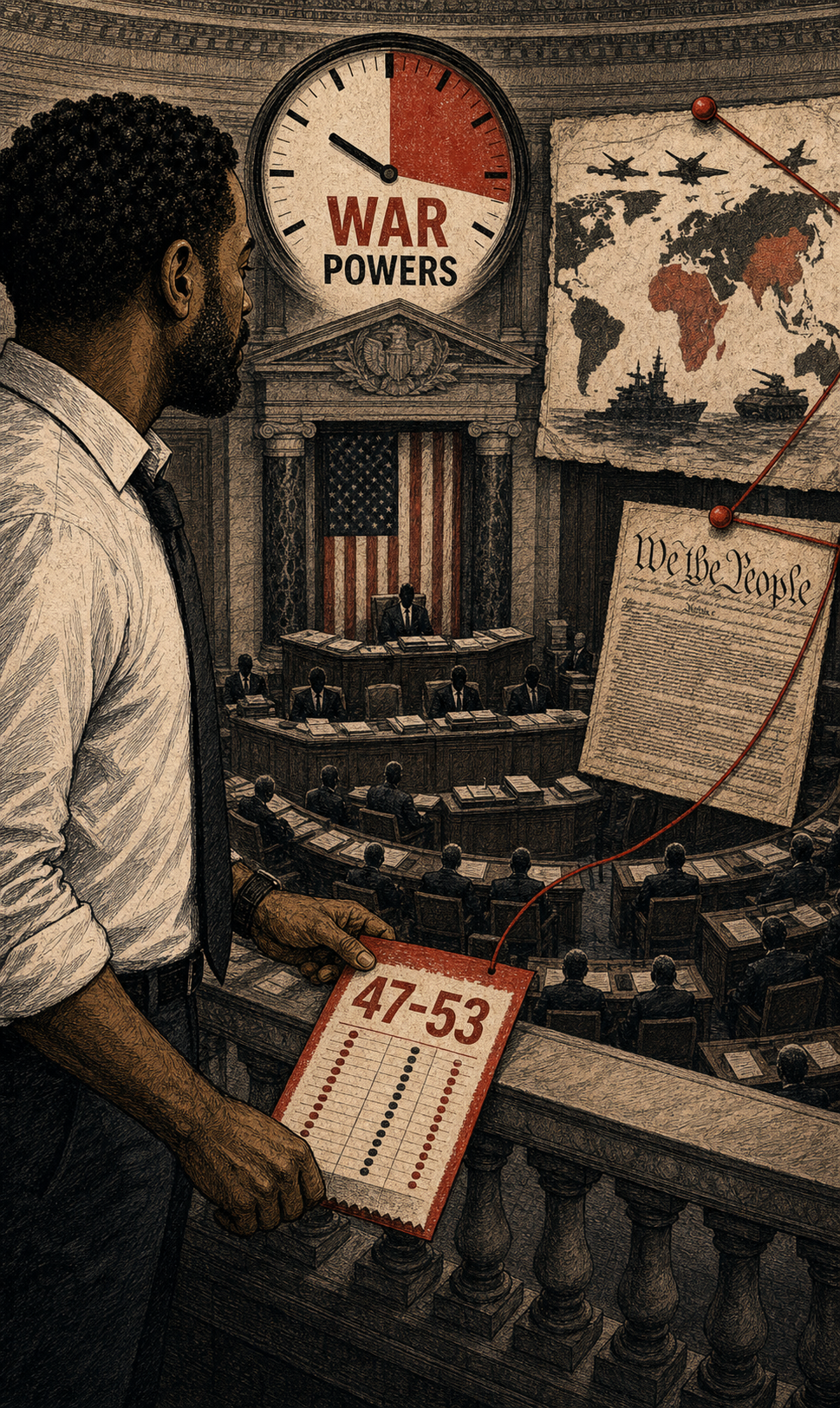
The Click That Explains The Whole Story
The receipt is not a metaphor. It is a roll call. Open it before the spin gets to you.
See The 47-53 Senate Receipt Read The War Powers Argument Make Your Senator Own ItMost people will argue the war. Start with the smaller, harder question: who voted to keep Congress out of it?
I have heard politicians praise the Constitution right up until the Constitution asks them to vote.
Everybody loves Congress's role in theory. Everybody loves checks and balances in speeches. Then the roll call opens.
On March 4, 2026, the Senate had a chance to move forward on S.J.Res.104, the Iran War Powers Resolution led by Tim Kaine and Rand Paul. The motion failed 47-53. Rand Paul was the only Republican to vote yes. John Fetterman was the lone Democratic no.
They said Congress matters. Then 53 senators voted like it did not. |
The Machine
War power is where cowardice dresses up as seriousness. Nobody wants to look soft. Nobody wants the attack ad. So the Senate finds a softer word.
Procedure. Motion. Discharge. Hostilities. Authorization.
Should one president be able to keep American forces in hostilities against Iran without explicit congressional authorization?
That was the question hiding inside the procedural wrapper. That is why the vote matters.
The Receipts
Receipt 01: The official clock. The U.S. Senate Daily Press recorded that at 5:23 p.m. the Senate rejected the motion to discharge S.J.Res.104 by 47-53.
Open the 47-53 recordReceipt 02: The resolution. The Senate Democratic schedule described S.J.Res.104 as a joint resolution to direct removal of U.S. forces from hostilities against Iran not authorized by Congress.
See what the vote was really aboutReceipt 03: The public argument. Kaine, Schumer, and Schiff said the resolution would ensure hostilities were explicitly authorized by Congress.
Read the sponsors' caseReceipt 04: The reporting. Hamed Ahmadi at NOTUS reported that Senate Republicans blocked the effort to curb Trump's war powers on Iran.
Read Hamed Ahmadi's reportReceipt 05: The quote. NOTUS quoted Lisa Murkowski saying she did not want the vote interpreted to mean she did not think Congress had a role. The role exists. The vote said otherwise.
Read another account of the voteThe Translation
The Senate did not vote on a poem. It voted on power.
Who gets to decide whether American forces stay in hostilities? Who has to explain the objective? Who owns the consequences when the war expands?
Congress loves oversight after the fact. After the strike. After the escalation. After the classified briefing. After the first bad headline.
But war power was not supposed to work like a reimbursement form. Congress does not get to become brave in the footnotes.
Send This To One Person
Ask them one question: if Congress has a role in war, why did 53 senators vote like the role was optional?
Find Your SenatorRead The Receipts Before The Spin
U.S. Senate Daily Press. The clean vote record and crossover note.
Sen. Tim Kaine. Kaine, Schumer, and Schiff's public case for explicit congressional authorization.
Hamed Ahmadi, NOTUS. The reporting frame and Murkowski quote.
Senate Democratic Caucus. The procedural wrapper around the actual war-power question.
The Washington Post. A second national account of the Senate rejecting the resolution.
Magic Link
If someone forwarded you this issue, skip the signup maze and join BTP here:
The Verdict
Do not let them hide behind procedure. The vote was procedural. The consequence was not.
Fifty-three senators voted to let one man keep the war without forcing Congress to own the decision clearly.
May the bridges we burn light our path forward.
Millions of developers use Wispr Flow to dictate code, write docs, and give coding agents better context. 89% of messages sent with zero edits. 4x faster than typing. Free on Mac, Windows, and iPhone. Try Wispr Flow free.