

The Peace Memo Had Bombs In It
Rubio sold diplomacy while Trump kept the strike option alive.

01 The cold open
The cruelest thing about Washington's Memorial Day ritual is that it has learned how to sound reverent while keeping the machinery of war warm.
The flags go up. The statements go out. The country is asked to remember the dead. And somewhere in the same government, someone is still treating war like a negotiation tactic.
That is why the Iran story matters.
On Saturday, the Associated Press reported that President Trump said a deal with Iran, including reopening the Strait of Hormuz, had been largely negotiated. One day earlier, AP reported that Secretary of State Marco Rubio said there had been only slight progress in the talks, while uncertainty remained over whether war would resume.
That is the sentence.
A peace memo is not peace if the bombs stay in the room.
02 The confession
I understand the instinct to cheer any sentence with the word peace in it.
Nobody normal wants another war. Nobody who has watched families bury the cost of other men's certainty should be casual about the possibility that a pause may hold.
But the room knows the difference between peace and leverage.
Peace is when the killing stops because the policy changed. Leverage is when the killing stops because someone thinks the threat is still useful.
That distinction matters after Memorial Day. It matters because the people who die for policy rarely get to sit in the room where the policy is dressed up as strength.
03 The machine
Rubio is the Cabinet member here because he is the public face of the diplomatic track.
AP reported Friday that Rubio described slight progress in Iran talks as Pakistan renewed mediation efforts and as the question of renewed war still hung over the negotiations. AP also reported that Trump had said days earlier he was holding off on a military strike because serious negotiations were underway.
Then came the Saturday statement.
Trump said a deal and the reopening of Hormuz were largely negotiated. He described a peace memorandum that still needed to be finalized by the United States, Iran, and other countries involved in the calls.
That sounds like progress.
It may become progress.
But progress is not the same as safety.
The same reporting says the war context is still live. The same administration that is asking the public to trust the peace track is also carrying the memory of a strike that was close enough to be called off.
That is the machine: diplomacy as the front room, force as the back room, and the public asked to applaud because the front room has nicer furniture.
04 The receipt
The AP anchor is not subtle. Trump did not simply say everybody wants peace. He said a deal on the war and Hormuz was largely negotiated, while AP reported the agreement still required finalization and did not resolve every hard question.
The Rubio receipt is even sharper. The Secretary of State's public language was not victory-lap language. It was slight-progress language. It was uncertainty language. It was diplomacy spoken with the possibility of resumed war still in the frame.
That is not a reason to root against the talks.
It is a reason to refuse the propaganda version of them.
When an administration sells peace while keeping a strike option in the background, the public deserves more than a patriotic adjective. It deserves the paper. It deserves the timeline. It deserves to know who is promising what, what is being traded, what is being postponed, and what happens if the performance of peace breaks down.
Because troops do not die for vibes.
They die after rooms like this decide the language has run out.
05 The translation
Here is the grocery-store version.
If your neighbor says he is ending a fight while standing on the porch with a lighter in his hand, you do not just ask whether he used the word peace.
You ask why he still has the lighter.
That is the Rubio-Iran story. The Cabinet is selling diplomacy. Trump is selling pressure. Memorial Day is selling reverence. The public has to ask whether the machinery of war is actually being shut down, or merely being held in reserve for the next threat.
06 The verdict
There is a right way to honor the dead.
It is not with a proclamation in the morning and brinkmanship by night.
It is not by making peace sound like branding while the strike option remains part of the sales pitch.
It is by telling the public the truth before the public pays the bill.
The truth is simple.
A peace memo is not peace if the bombs stay in the room.
07 State of the Race
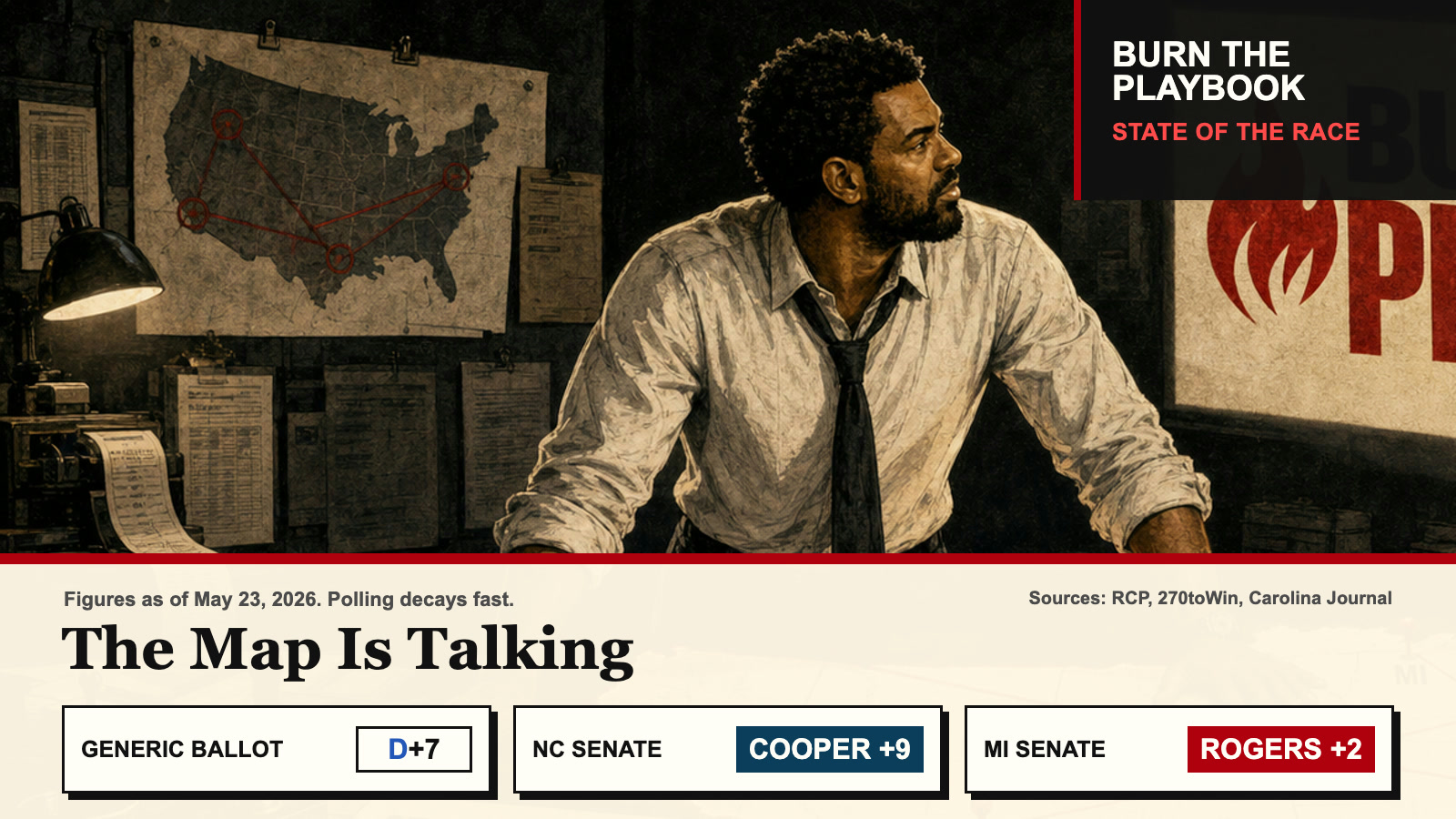
The political map is already warning us why this matters. The same voters being asked to absorb war, prices, executive power, and chaos are the voters who decide the next Congress.
Polling decays fast, but the direction of travel is clear: the war room and the ballot box are not separate stories.
08 What to do this week
Forward this to one person who hears the word peace and stops reading.
Then ask the question every Memorial Day should leave behind in a democracy: who gets to decide when diplomacy has failed, and what proof does the public see before somebody else's kid is asked to carry the consequence?
09 Accountability Jobs
The people who fight executive overreach need staff, not applause.
- Current Openings - Brennan Center for Justice - New York / Washington / hybrid - apply via current openings
- Current Openings - States United Democracy Center - Remote / Washington - apply via current openings
10 Read Before The Room Rebrands It
- Munir Ahmed, Samy Magdy, and Matthew Lee, Associated Press - the Iran/Hormuz deal report that makes the peace claim testable.
- Sam Mednick, Samy Magdy, and Munir Ahmed, Associated Press - the Rubio talks report that shows the Cabinet language was still cautious.
- Associated Press - the strike-pause context showing how close the force option had already come.
- The White House - the Memorial Day proclamation that gives the issue its public contrast.
May the bridges we burn light our paths forward.
Subscribe to Burn the PlaybookWritten by Michael Starr Hopkins. Forward freely.