
In partnership with

Wispr Flow turns your voice into professional, send-ready text. Speak your reply naturally and get polished output for email, Slack, or any app. Try Wispr Flow free.
Nine Wallets Bet on the Airstrike. They Were Right 98% of the Time.
Nine accounts, created days before U.S. bombs hit Iran, bet almost only on American strikes — and won 98% of the time. They cleared $2.4 million, then moved the money into Bybit, Binance, and HTX. Today is the day Congress decides whether anyone finds out who they are.
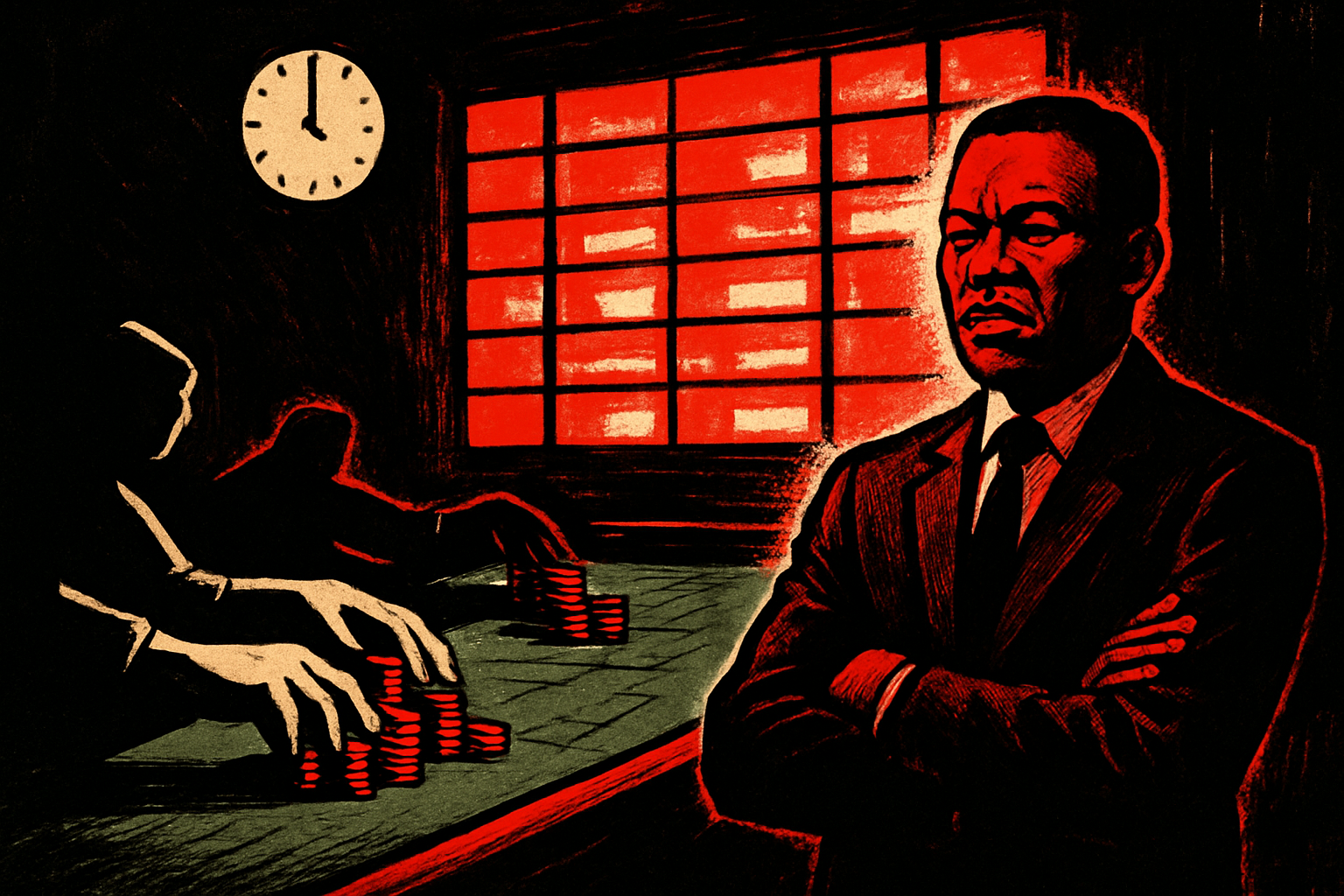
Illustration: Burn the Playbook
My new op-ed in The Hill on the injustice of Trump's insurrection-fund payouts. Read it →
New from Burn the Playbook: "Trump Made 3,700 Stock Trades in 90 Days — And It's 100% Legal." Watch the Short →
The cold open
A surprise attack is supposed to surprise the enemy. That is the entire point of one — the secrecy, the sealed launch windows, the generals who go on television and say we will not telegraph our moves. The whole apparatus exists so the target never sees it coming.
So explain this. On the betting site Polymarket, nine linked accounts — spun up only days before America's first strikes on Iran in late February — wagered, almost exclusively, on U.S. military operations. When the strikes would land. Whether Iran's Supreme Leader would be removed. When a ceasefire would be announced. They won 98% of the time across more than 80 bets, and walked away with $2.4 million, according to the blockchain-analytics firm Bubblemaps, whose on-chain trace found some of those shares bought for about a dime apiece, hours before the first explosions were reported in Tehran.
You cannot reliably bet on a surprise attack. Unless, to you, it was never a surprise.
The confession
I've spent two decades around the rooms where Washington decides things — campaigns, congressional offices, the green rooms where people explain on camera why the latest outrage is actually fine. This town will monetize anything that isn't nailed down: access, a vote, a verdict, a war.
But there's a line I assumed even this place wouldn't cross, because crossing it isn't ordinary graft — it's closer to treason with a receipt. The line is the strike calendar. The moment somebody turns the timing of a bombing into a payout, the bombing stops being only a national-security event. It becomes a number a person with the right information can be right about, over and over, while everyone else is still reading the morning headlines.
The machine
Here is how a secret becomes a slot machine. A prediction market lets you bet on whether a thing will happen. For ordinary public events, the "wisdom of crowds" is the sales pitch — thousands of strangers pricing in what they read and guess. For classified military operations, "the wisdom of crowds" is a polite euphemism for whoever has the schedule. There is no crowd wisdom about a strike that hasn't been announced. There is only information you are supposed to have, or information you are not.
Then layer in the piece that turns a scandal into an indictment of the system. The agency that's supposed to police this — the CFTC — has kept backing prediction markets even as House members pointed at the smoke. This isn't a back-alley operation. It's a legal venue with a federal stamp, offering contracts on the outcomes of American wars. Polymarket already had to apologize for letting users bet on whether a U.S. pilot would be shot down. The apology came. The machine kept running — to $529 million in Iran-strike volume (Bloomberg).
The receipts
- Nine linked accounts. 98% win rate. 80-plus bets. $2.4 million. Created days before the late-February strikes; betting almost only on U.S. operations — strike timing, leadership removal, the ceasefire (Bubblemaps, via QZ + IBTimes).
- Cheap shares, because the outcome wasn't supposed to be knowable. Some bought for ~10 cents, hours before the explosions — the price you get when the market thinks a thing is unlikely and you know better.
- The money didn't stay anonymous. Profits moved out through Bybit, Binance, and HTX — exchanges that, unlike Polymarket, require real-name ID to cash out.
- Congress moved. On May 11, Rep. Chris Pappas and six colleagues demanded Oversight Chair James Comer subpoena the records and respond by today. Comer — a Republican — has confirmed a probe, subpoenas possibly to follow. Separately, 53 House Democrats are pressing DOJ to prosecute.
A 98% win rate across 80-plus bets is not a hot streak. On a fair coin you're deep into one-in-a-billion territory. That's not the signature of people who guessed well. It's the signature of people who knew.
The translation
Strip the euphemisms all the way down. "Suspicious trading activity on regulated event contracts" means: somebody appears to have known when American and Israeli forces were going to kill people, and used it to get rich before the country — or the targets — found out. Those accounts front-ran a war, the way a crooked broker front-runs a stock, except the underlying asset is a strike package. And it's built to repeat: a market that pays out on secret bombings is a standing invitation to get the calendar and get paid.
This is on-chain. Here's how they get caught.
Here's the part that should make the "we can't identify anonymous traders" excuse collapse. Polymarket runs on a public blockchain and requires no ID to bet — which is what makes it feel anonymous. But anonymous and untraceable aren't the same thing. Every wager and transfer those nine wallets made is written to a permanent public ledger. That's how Bubblemaps clustered them from the outside, with no subpoena.
And then the wallets did the one thing that ends the anonymity: they cashed out — into Bybit, Binance, and HTX, exchanges that hold real names, real bank accounts, and government IDs. The blockchain links the bets to the wallets. The exchanges hold the last link: wallet → bank account → name.
So the subpoena that matters isn't only to Polymarket. It's to Bybit, Binance, and HTX. The records aren't lost. They're sitting in three compliance departments right now, waiting for someone with the authority to ask.
The verdict
A subpoena is a piece of paper until somebody signs it, and "an investigation is underway" is the most renewable resource in Washington. Today is the deadline. By tonight, Comer's committee has either named how it will subpoena Polymarket, Bybit, Binance, and HTX — or it has let the clock run out and told you, without saying it, that the people who bet on the bombs keep their winnings and their anonymity.
You can't bet on a surprise attack unless somebody told you it wasn't a surprise.
The bets are on-chain. The names are at the exchanges. The deadline is today.
This is the first installment. Burn the Playbook is building the money-map behind those nine wallets and digging into the regulator that kept the lights on.
What you can do today
- Call House Oversight (202-225-5074): "Subpoena Polymarket — and Bybit, Binance, and HTX — for the Iran-strike account records. Today."
- If your representative sits on Oversight, say it to their district office.
- Forward this to one person who thinks Washington corruption is too abstract to matter.
The news you should know today
- Trump ousted Thomas Massie. His hand-picked challenger — ex-Navy SEAL Ed Gallrein — beat the Kentucky Republican in a roughly $32M race, the most expensive U.S. House primary on record. Massie had crossed Trump on spending, the Iran war, and the Epstein files. (NPR)
- The $1.776B "lawfare" fund is headed for a court fight. Attorneys say Congress is the best shot to block it — while Jan. 6 rioters, George Santos, and Rod Blagojevich are reportedly eyeing payouts. (CNBC)
- Primary night held Trump's line. Kentucky was the marquee race, but Republican incumbents who crossed him went down across several states. (NBC News)
The numbers
- Generic ballot: Democrats roughly +7 — the bluest of the cycle (Silver Bulletin D+6.6; RealClearPolitics D+7.1). (Silver Bulletin)
- Trump approval: about 38% approve / 58% disapprove — net -20, a second-term low, and underwater in every battleground (MI -19, GA -20, NV -19, WI -14, NC -14, PA -13, AZ -11). (Newsweek)
- — figures as of May 22, 2026.
The jobs
The people who pry these records loose work here, not at the party committees. (Roles rotate — open the careers page for current listings.)
- Investigator / Researcher — POGO — DC/remote — pogo.org/careers
- Litigation / Investigations — Campaign Legal Center — DC — campaignlegal.org/careers
- Research & Investigations — CREW — DC — citizensforethics.org/about/careers
- Tech-accountability — Demand Progress — remote — demandprogress.org/about/jobs
- Financial reform — Public Citizen — DC — citizen.org/about/jobs
What's worth your click
- Bubblemaps / QZ — the on-chain trace.
- Akshay Puri, IBTimes UK — the account-by-account breakdown.
- SBC Americas — the CFTC-vs-Congress tension.
May the bridges we burn light our paths forward.
Subscribe to Burn the PlaybookWritten by Michael Starr Hopkins. Forward freely.
Investors see ANOTHER return from Masterworks (!!!!)

That’s 6 sales in 7 months. 29 all time. And the performance?
16.5%, 17.6%, and 17.8%, net annualized returns on sold works held longer than one year (See all 29 at Masterworks.com)
It’s not from stocks, private equity, or real estate… it’s from contemporary and post war art. Crazy, right?
With Masterworks, you don’t need to be a BILLIONAIRE to invest in multi-million dollar art anymore.
Historically, the segment overall has had attractive appreciation and low correlation to stocks.*
Masterworks targets works featuring legends like Banksy, Basquiat, and Picasso, identifying what they believe to have significant long-term appreciation potential, not just at the artist level but at the level of individual artworks.
As one of the largest players in the art market, with $1.3 billion invested over 500 artworks, they pass critical advantages through to their 70,000+ members to add art to their portfolios strategically.
Looking to diversify your investments in 2026?
*According to Masterworks data. Investing involves risk. Past performance is not indicative of future returns. See important Reg A disclosures at masterworks.com/cd.