
PLAYBOOK
May The Bridges We Burn Light Our Path Forward.
Gets Roasted
The common thread is exposure: joaning makes fake power small, Obama made Trump sit inside the joke, and veterans are making the forever-war pitch answer the room.
Send it to the person who knows a costume is not the same thing as power.
Share This IssueThe Wall Thesis
This weekend issue is about one thing: exposure.
Sometimes fake power arrives as a rich man's costume: the borrowed confidence, the television persona, the bully treated like a statesman because everyone in the room has agreed to keep pretending.
Sometimes it arrives as war language: escalation, deterrence, posture, strength, resolve. All the words that make an open-ended mission sound like weather instead of a choice.
The answer is the same in both rooms: make the act visible.
Joaning does that culturally. A veterans town hall can do it politically. One uses timing, ridicule, and recognition. The other uses service credibility, local memory, and the question an incumbent least wants to answer:
What is the strategy?
Keep the receipts free. Burn The Playbook is built for readers who want the document trail, the vote, and the campaign move in one place.
The Room Sees The Costume
There is an old Black art called joaning, pronounced like joe-nin', with the g left somewhere on the sidewalk.
Some generations called it playing the dozens. Some called it ranking, cracking, snapping, or roasting. Now people say somebody got cooked. The names change. The ritual is older than the slang.
A circle forms. Somebody arrives with too much confidence, the wrong shoes, a bad story, a fake tough-guy act, a haircut with a public-relations problem. The room notices. Then the room decides whether he can survive being seen.
That is the part outsiders often miss. Joaning is not only insult. At its best, it is truth with timing. It is the social x-ray.
It says: your costume is showing.
It says: the confidence is borrowed.
It says: we know the gap between who you are pretending to be and who you are.
That can be cruel. It can go too far. But the tradition lasts because it teaches a public survival skill. You learn how to take embarrassment without collapsing. You learn how to answer without begging. You learn how to hear weakness inside loudness. You learn that being laughed at will not kill you.
For Black people in America, that was never a small lesson.
Racism has always tried to use humiliation as a governing tool: make people feel poor, ugly, criminal, loud, dirty, out of place, lucky to be tolerated. Joaning takes shame and makes you practice with it. It does not remove the wound. It teaches you how to keep your face while people are watching.
It also teaches you how to spot fraud.
In communities where official power was denied, language became a form of power. If you acted richer than you were, tougher than you were, smarter than you were, holier than you were, somebody was going to notice. The joke was a social audit. It cut down false superiority. It reminded everyone that nobody was too important to be laughed at.
That is why joaning matters politically. Not because politics needs more cruelty. It does not. Public life is already mean enough and usually not even clever about it.
The lesson is not nastiness.
The lesson is exposure.
Obama Let The Room See Trump
That is what Barack Obama understood at the 2011 White House Correspondents' Dinner.
Donald Trump was in the room after pushing the racist birther lie: the demand that the first Black president prove he belonged in the White House. Show your papers. Explain your presence. Prove you are not trespassing.
Obama could have answered with a lecture. He could have treated Trump like a serious man making a serious argument.
Instead, he made the act small.
He placed Trump where he belonged: with fake moon landings, Roswell speculation, attention politics, and the unseriousness Trump wanted everyone to mistake for dominance. It worked because Obama did not chase the lie. He made the room see the act.
Black tape note: the point was not only to insult Trump. The point was to make the room see him clearly.
People have debated whether that night pushed Trump deeper into politics. Maybe. Maybe not. But Obama did not create Trump's cruelty. The birther lie came first. The demand that Obama prove his legitimacy came first.
What Obama revealed was simpler and more useful:
Trump could be embarrassed.
That matters because Trump's power has always depended on performance. He performs wealth. He performs toughness. He performs patriotism. He performs certainty. He performs dominance. Too much of politics and media still confuse the performance for strength.
But strength does not need constant praise. Strength does not melt down when laughed at. Strength does not need every room to pretend the costume is real.
Joaning breaks the agreement.
It says: we see you.
That is the bridge to the Iran story. The most useful attack on fake power is often not a louder speech. It is a room that refuses to keep pretending.
The Room Sees The War Costume
War language has costumes too.
It dresses uncertainty as strategy. It dresses escalation as resolve. It dresses congressional evasion as patriotism. It dresses an open-ended mission as a temporary necessity that somehow keeps requiring more time, more trust, and fewer questions.
That is why JoAnna Mendoza's veterans town hall in Arizona's 6th Congressional District matters.
AZPM's Nick Rommel reported that Mendoza held a veterans town hall in Tucson on Tuesday, April 28, 2026. The Iran war was not a side issue there. It became the room. Mendoza, a Navy and Marine veteran running against Republican incumbent Juan Ciscomani, criticized the conflict in front of voters whose memories were not theoretical.
This is the campaignable version of the Iran story.
Not the cable-panel version. Not the think-tank-map version. Not the Washington version, where escalation becomes a word people say as if no household has to absorb it.
The campaignable version is a veteran-heavy district where Donald Trump promised no forever wars, then delivered language that veterans hear through Iraq, Afghanistan, and Vietnam.
The important thing about Mendoza's town hall is not that it was "anti-war." That frame is too flat and too easy for Republicans to caricature. If the argument becomes anti-war versus strength, the incumbent knows the costume. He can talk about supporting the troops, dangerous enemies, and seriousness while avoiding the operational question.
Mendoza did not give him that clean target.
According to AZPM, she asked what the strategy was.
That is the line on the wall.
Not anti-war as identity.
Strategy as demand.
In a veteran room, "what is the strategy?" is not a seminar question. It is a family question. It is a deployment question. It is what people ask when they know the difference between a mission and a mood.
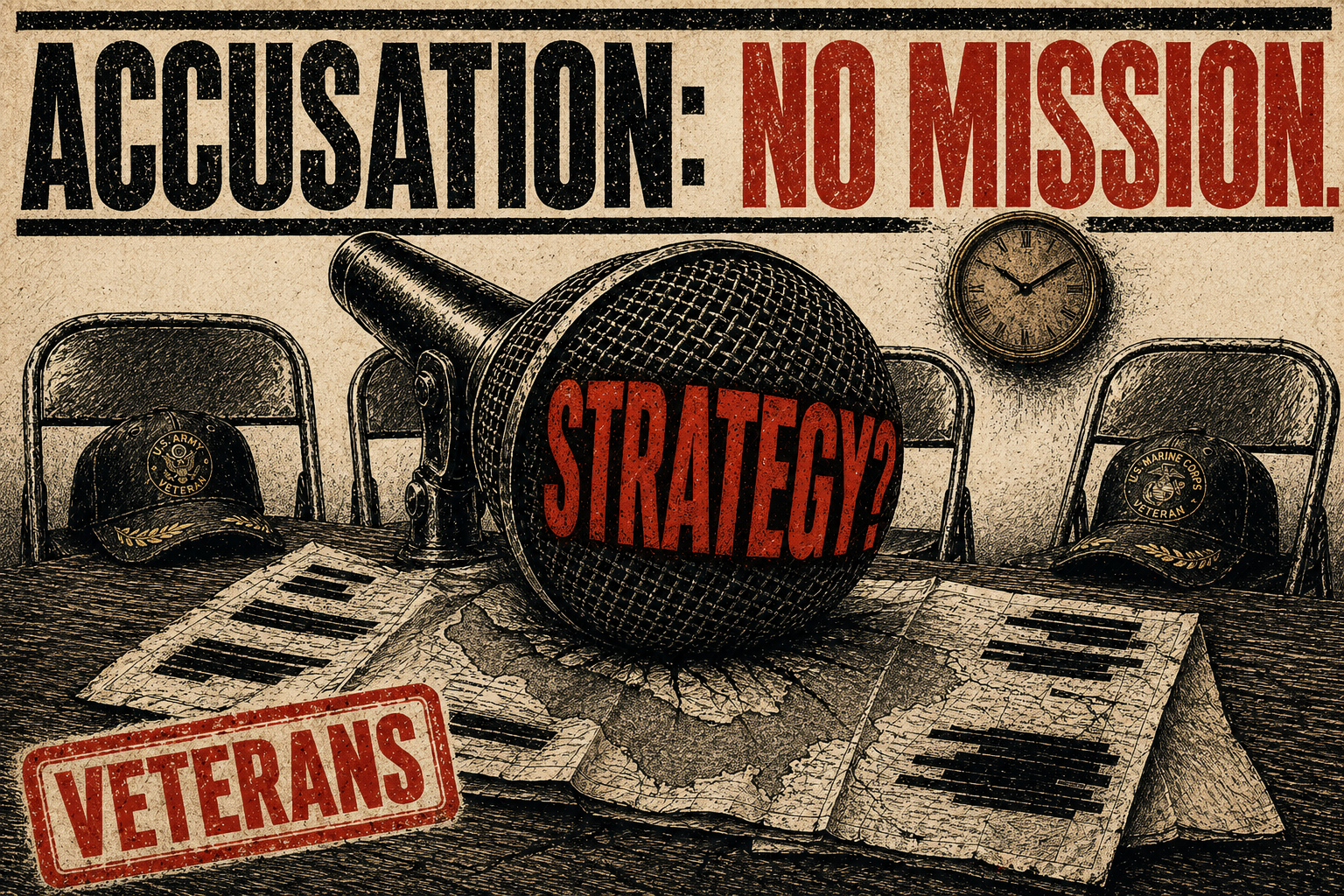
Black tape note: the room is not asking for a slogan. It is asking for the mission.
AZ-6 Is The Test Wall
Arizona's 6th District is not a metaphor drawn for pundit convenience. It is a live House battleground with a service footprint.
AZPM reported that more than 80,000 veterans live in the district, about 12% of its voting-age population and roughly double the national average. The district includes Fort Huachuca and Davis-Monthan Air Force Base. Cook Political Report rates the seat a toss-up. Ciscomani won by fewer than 6,000 votes in 2022 and fewer than 11,000 in 2024.
That is the House majority compressed into a room where veterans can ask whether the promise they heard was real.
One attendee in AZPM's story had voted for Trump in 2024. He was a 58-year-old Army veteran who had served in Iraq and Afghanistan. He said Trump's promises to avoid foreign wars had persuaded him. Now he was watching the opposite.
That voter is not automatically becoming a Democrat. Treating him that way would be malpractice. He may still distrust both parties. He may still prefer Republican language on the border, spending, policing, or culture. He may not want to be told his previous vote made him foolish.
What he may be willing to say is simpler and more dangerous:
This is not what I was promised.
Campaigns underestimate the force of that sentence.
Voters tolerate disagreement more easily than betrayal. A voter who backed Trump because he wanted a hard line abroad is not the same as a voter who backed Trump because he believed "America First" meant avoiding another Middle East war. If the second voter now hears Vietnam-length signals, the opening is not ideological conversion.
It is contract enforcement.
You said no forever wars.
Why are we hearing forever-war language?
Who authorized this?
What does success mean?
How does it end?
Those questions are not left-wing. They are not pacifist. They are not campus-coded. They are kitchen-table questions in a military household. They are questions a spouse asks before bags are packed. They are questions veterans ask when they recognize the first draft of a story they have already lived through.
Let The Room Ask
The first mistake is to call this an anti-war campaign.
The better frame is strategy.
Not because strategy is softer. Because it is sharper.
"What is the strategy?" forces an incumbent to leave the safety of sentiment and enter the terrain of responsibility. It is not an objection to war in general. It is a demand for a plan in this war, authorized by the right body, explained to the people most likely to pay for it, and measured against a definition of success that does not change every time the news gets worse.
For Mendoza and any challenger in a veteran-heavy district, the field message is direct:
AZ-6 has lived the cost of vague missions. The district deserves a representative who will ask for the strategy before writing Trump another blank check.
At the doors, do not begin with Iran. Begin with trust:
Did you vote for Trump partly because he said he would avoid foreign wars?
That question is dangerous because it is respectful. It does not accuse. It lets the voter explain the promise in his own words.
Then move:
What would you need to hear from Congressman Ciscomani to know there is a real strategy in Iran?
Now the incumbent is being evaluated. The voter defines seriousness: exit plan, congressional authorization, no ground troops, clear objective, no blank check, distrust of both parties. All of those answers are usable because they reveal what accountability sounds like to that voter.
For phones, use the shorter test:
Do you think Congress should have to vote on whether this war continues?
For mail, make it look like a mission brief, not a peace poster.
Front: What is the strategy?
Inside:
- What is the objective?
- Who authorized it?
- How does it end?
Back: the incumbent's posture. Supported strikes. Opposed ground troops. Voted against curbing Trump's war power. Still no strategy for AZ-6 families.
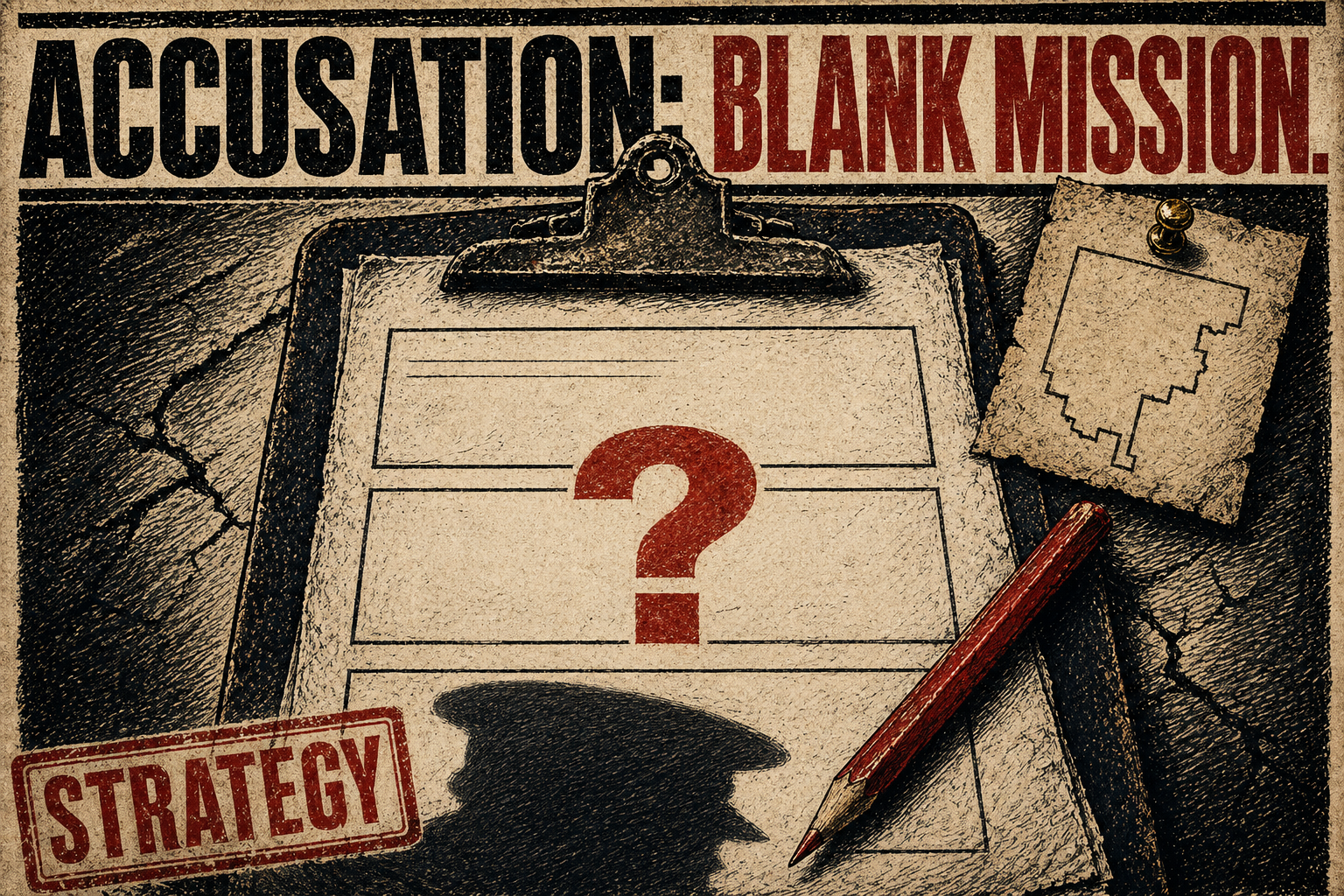
Black tape note: blank fields are the attack.
For digital, the strongest ad is not Mendoza talking for 30 seconds.
It is a veteran asking Ciscomani one question.
Open on silence. A kitchen table, union hall, VFW-style room, or base-adjacent neighborhood. No trauma performance. No stock battlefield footage. A steady voice:
I served in Iraq. I voted for Trump because he said no more forever wars. Congressman Ciscomani, what is the strategy in Iran?
Then the three-point record:
Supported strikes.
Opposed ground troops.
Voted against curbing Trump's war power.
Close: Ask him. What is the strategy?
Sticker Sheet
Make fake power stand still. The point is not to be cruel. The point is to stop treating performance as proof of strength.
Ask the mission question. Do not lead with "anti-war." Lead with: What is the strategy?
Enforce the promise. Trump promised no forever wars. Ask voters who believed him what would count as keeping that promise now.
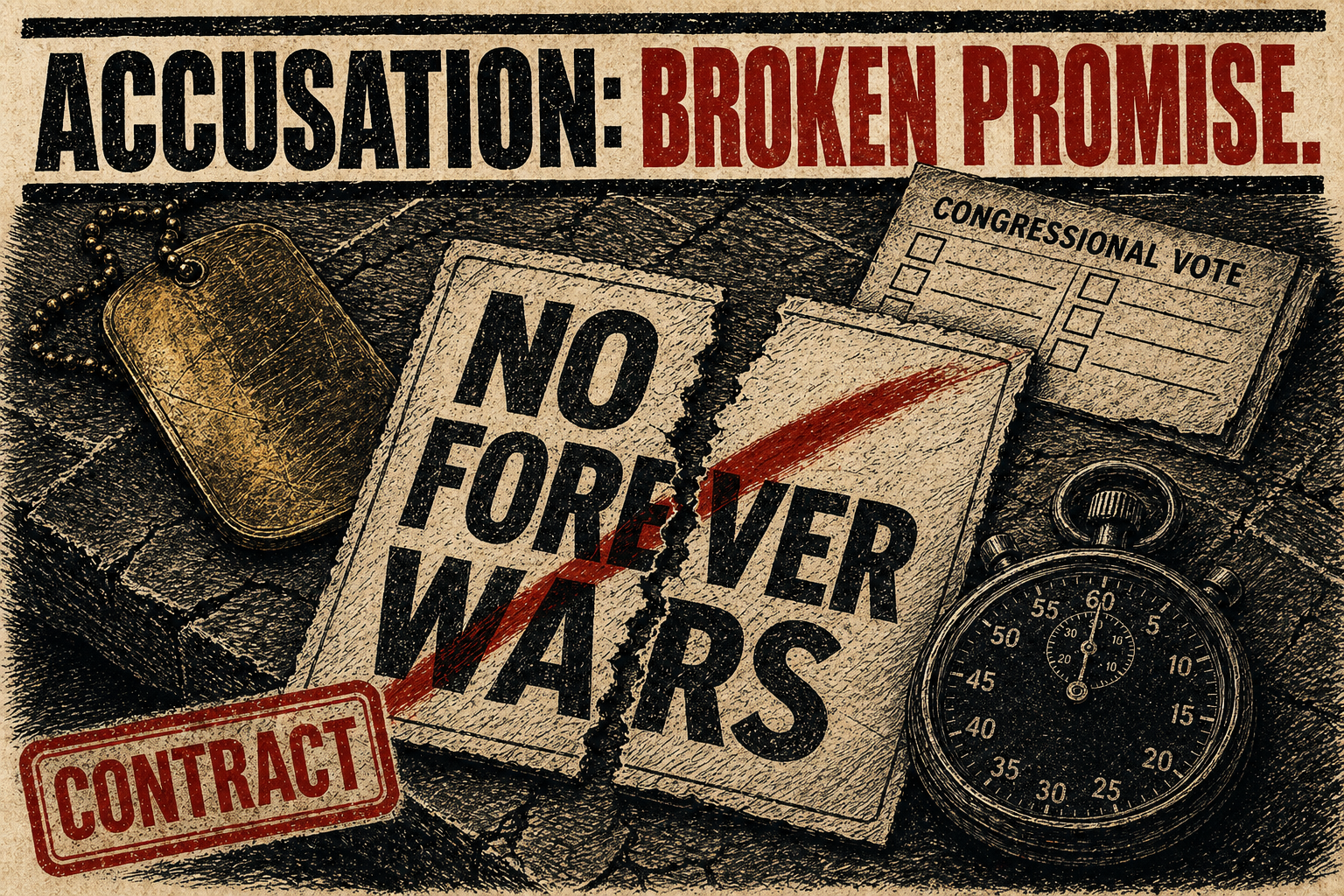
Black tape note: no forever wars means no blank checks.
Let veterans ask. Put a local veteran on camera asking Ciscomani for the strategy. Let the silence carry the attack.
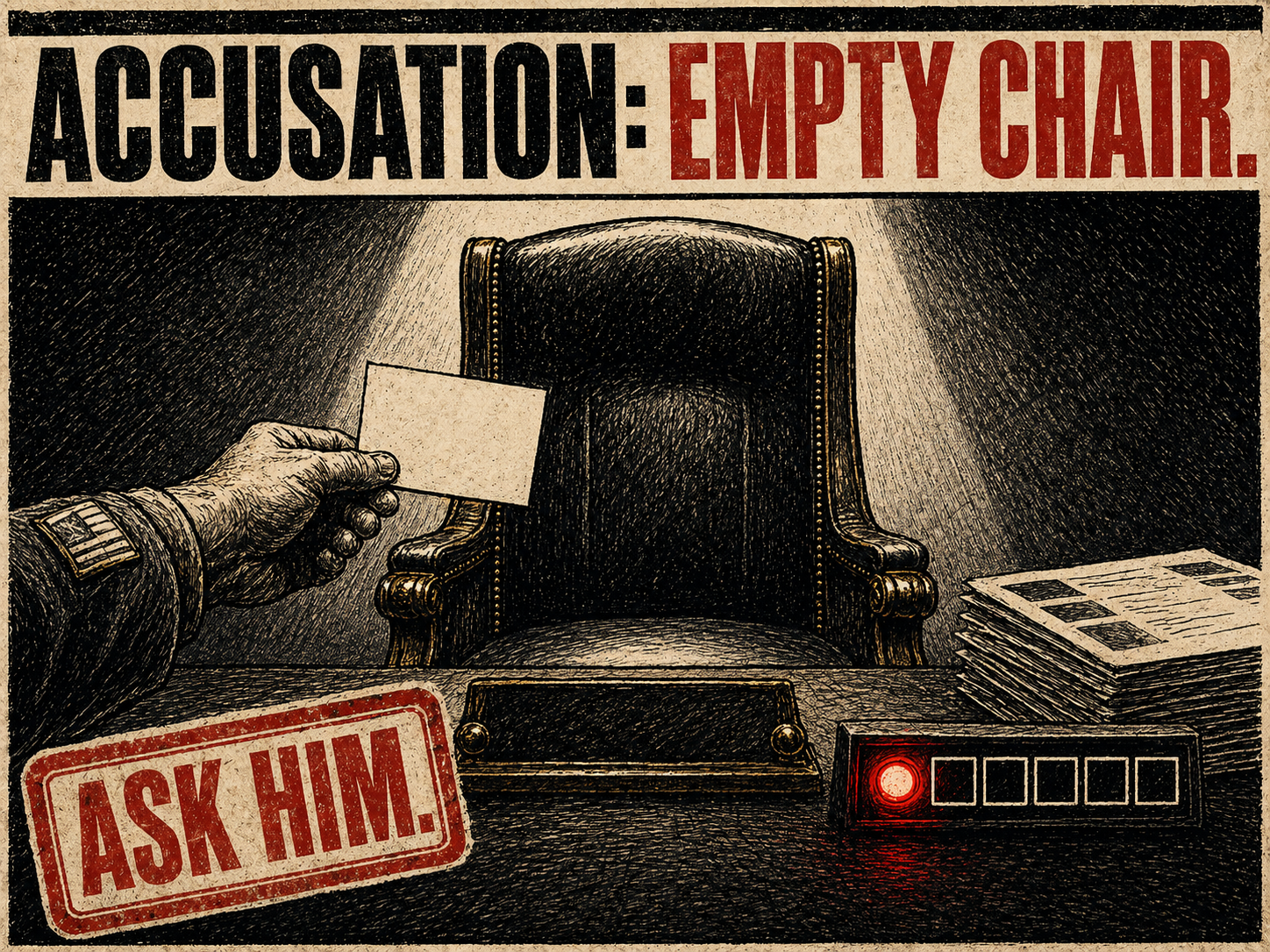
Black tape note: the empty chair is part of the message.
Polling On The Wall
The town hall story lands in a sour national environment for the Iran war.
AP-NORC polling reported Trump at 32% approval on Iran in April 2026. Axios summarized AP-NORC and Pew data in March showing broad public skepticism toward U.S. action against Iran, including roughly six in ten saying the action had gone too far or disapproving of Trump's handling.
That does not automatically make a voter anti-war.
It does make the strategy question campaignable.
Publication Update
Since this package was drafted, the White House has tried to move the war-powers fight onto technical ground. AP reported on May 1 that the Trump administration argued the Iran war had been "terminated" before the 60-day deadline because of an early-April ceasefire. AP also reported on May 2 that Trump was reviewing a new Iranian proposal to end the war. Axios reported the same day that Trump was still leaving the door open to new strikes if Iran "misbehaves."
That does not bury the AZ-6 question. It sharpens it.
If the war is over, what did the mission achieve? If it is not over, who authorizes what comes next? If new strikes are still possible, what exactly is the strategy?
Reach the room that reads the receipts. Campaign operators, organizers, lawyers, staffers, and political obsessives read BTP for the play beneath the headline.
Campaign Jobs Board
Reader-to-worker pipeline, no velvet rope:
- VoteVets careers
- Swing Left Voter Contact Director
- Run for Something jobs
- Working Families Party Senior Organizer
- Working Families Party Temporary Electoral Organizer
- Greenlight America Regional Campaign Manager, Central
- The Redress Movement Senior Campaign Organizer
Website / Referral / Ad Desk
This issue stays free in the inbox. The monetization sits around the work: referrals, sponsorships, ads, and jobs.
Use your Beehiiv referral link
Receipts
- Britannica: The Dozens
- Britannica: Signifyin'
- Obama White House transcript, 2011 WHCD remarks
- Obama White House archive, long-form birth certificate release
- AZPM, April 29, 2026: Iran war sways voters in tight Arizona congressional race
- Rep. Juan Ciscomani official vote record: Nay on H.Con.Res.38, Iran War Powers Resolution
- VoteVets PAC endorsement of JoAnna Mendoza
- Cook Political Report AZ-06 race page
- AP-NORC / AP polling on Trump, Iran, economy
- Axios polling roundup on Iran-war skepticism
- AP, May 1, 2026: Trump administration says war in Iran has been "terminated" before 60-day deadline
- AP, May 2, 2026: Trump says he is reviewing a new Iranian proposal to end the war
- Axios, May 2, 2026: Trump says new strikes possible if Iran misbehaves
May the bridges we burn light our path forward.
Keep BTP free: sponsor the next issue, refer a reader, or send a tip.
Sponsor The Next Wall You are receiving Burn The Playbook because this address is subscribed to the newsletter.
Unsubscribe | Manage preferences
Stop babysitting your coding agents. A context engine gives agents the right context for every task, so they stay on track without the correction loops. Join us for a FREE webinar on May 6 to see how it works. Register now