
In partnership with

Become An AI Expert In Just 5 Minutes

If you’re a decision maker at your company, you need to be on the bleeding edge of, well, everything. But before you go signing up for seminars, conferences, lunch ‘n learns, and all that jazz, just know there’s a far better (and simpler) way: Subscribing to The Deep View.
This daily newsletter condenses everything you need to know about the latest and greatest AI developments into a 5-minute read. Squeeze it into your morning coffee break and before you know it, you’ll be an expert too.
Subscribe right here. It’s totally free, wildly informative, and trusted by 600,000+ readers at Google, Meta, Microsoft, and beyond.
| Washington, D.C. | Wednesday, May 6, 2026 |
2026 Watch / War Powers
BURN THE PLAYBOOK
May The Bridges We Burn Light Our Path Forward.
All burns original. Every name sourced. Every comfortable version killed.
Senate / Iran / 47-50
Clock Blockers
Fifty senators voted to keep an active war off the Senate floor.
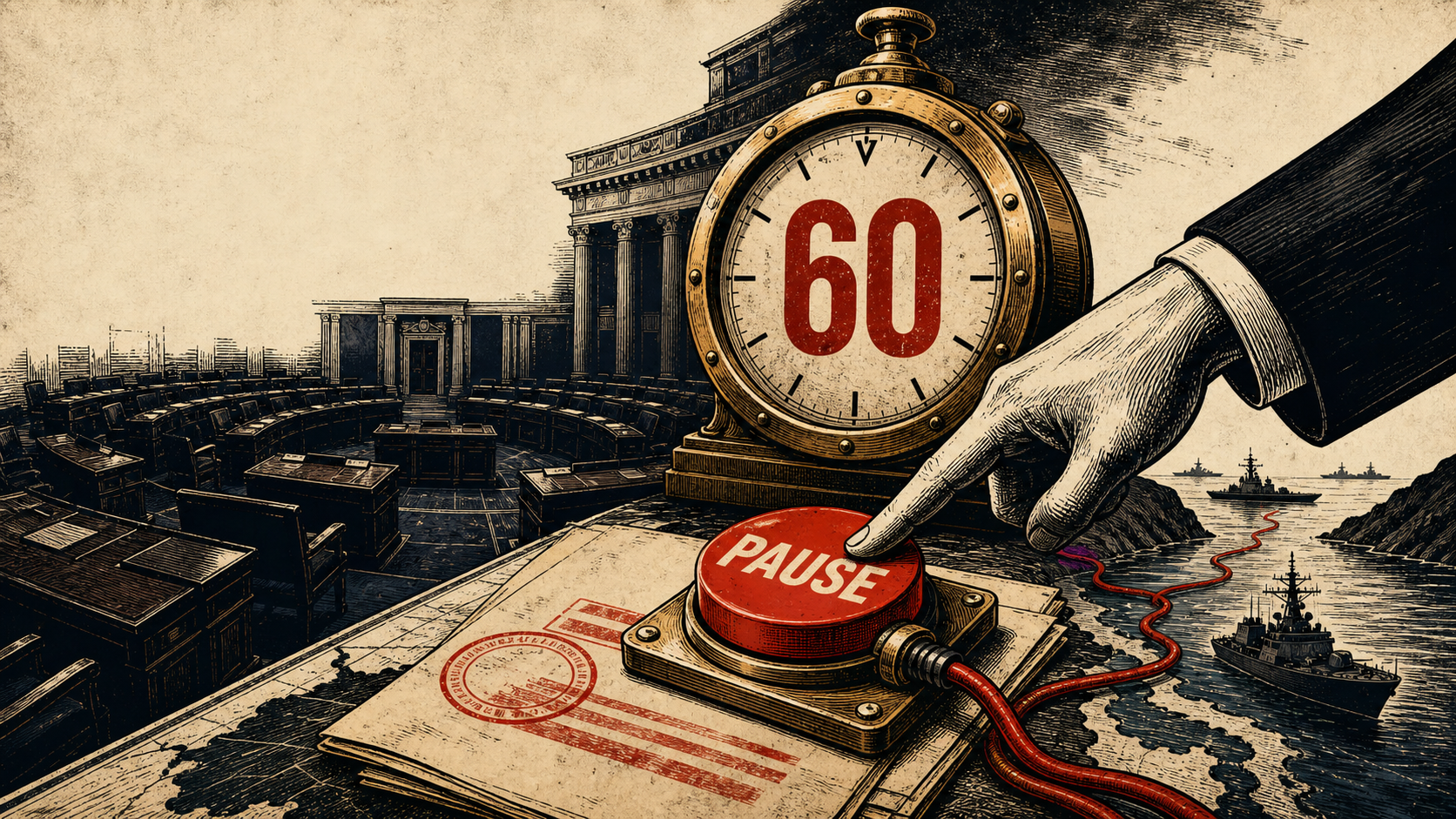
Fifty senators voted to keep an active war off the Senate floor.
The vote was not about gas prices. Not about the families staring at deployment alerts. Not about the service members still sitting inside the blast radius of somebody else's legal theory.
The vote was about the clock.
That is the trick. That is the whole game. And from here on, the fifty senators who pulled it have a name.
The Clock Blockers.
The War Powers Resolution gives Congress a deadline. Sixty days. The president sends American forces into hostilities without authorization, the president comes back to Congress for a vote — or brings the operation to an end. That is not a polite suggestion. That is the law.
Donald Trump hit that deadline on May 1.
So the administration tried to make the deadline disappear.
Pete Hegseth said it out loud, under oath, on camera, in a hearing he chose to attend. A ceasefire, he told the Senate Armed Services Committee, can pause the War Powers clock. Or stop it.
Then Trump sent Congress a letter saying hostilities with Iran had "terminated." Then he left himself a back door: more strikes if Iran "misbehaves."
That is not peace. That is a reset button with missiles attached.
The Receipt
Start with the dates. The dates are the story.
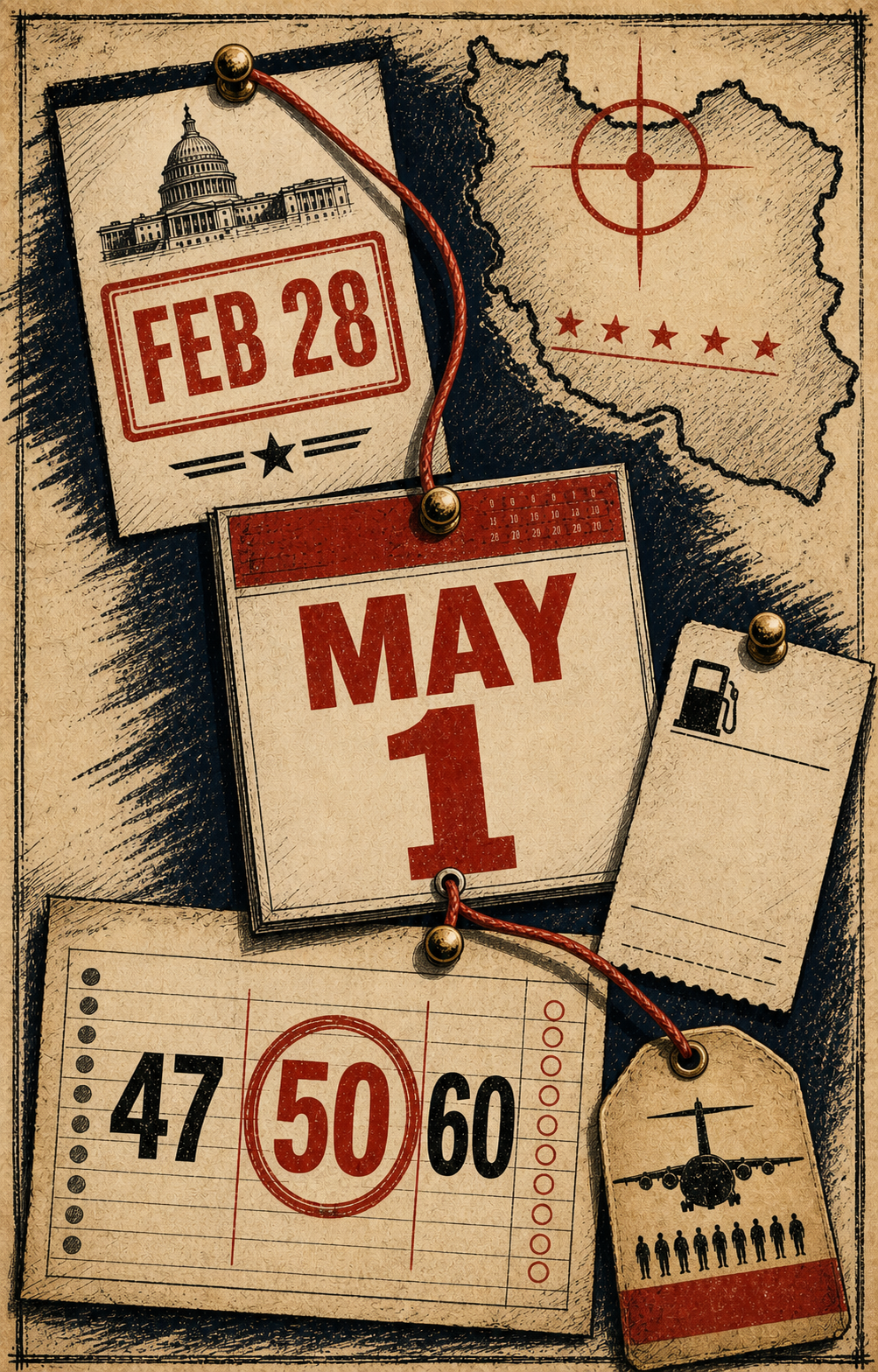
February 28. Trump notifies Congress that U.S. forces have begun hostilities involving Iran.
April 30. The Senate tries to force the question one day before the deadline. The motion to discharge Adam Schiff's Iran War Powers resolution fails, 47-50.
May 1. The clock runs out. The administration says it didn't. The statute says it did.
That number — 47-50 — is the first campaign asset. Public record. Look it up.
Forty-seven senators voted to make Congress do its job. Fifty voted to make sure it didn't have to. Those are the clock blockers.
Susan Collins and Rand Paul crossed the aisle. John Fetterman was the only Democrat in the no column.
Collins and Paul are not heroes for this. They are reference points. They make the rest of the Republican caucus easier to explain. Fetterman is a separate file. We will get to him.
The Trick
The administration's theory is simple enough to fit on a bumper sticker and slippery enough to keep a hallway full of lawyers in private school.
Ceasefire pauses the clock.
Defense News caught Hegseth's version on the record at Senate Armed Services: a ceasefire means the War Powers "60-day clock pauses, or stops." The statute says "within sixty calendar days." The statute does not mention a ceasefire. The statute does not mention a pause. Read it. It is shorter than the menu at most diners.
If the clock can be paused whenever the president says the shooting has paused, then Congress did not build a deadline. Congress built a suggestion box.
The Precedent
Here is what every president from this one forward just learned.
If you do not want a vote, do not call it a war. Call it a kinetic action. Send Congress a letter that says "terminated." Then claim a ceasefire — yours, theirs, anyone's — paused the clock.
The next administration does not have to be Republican to use this. It only has to be willing.
That is the precedent the clock blockers just wrote. They will not be the ones who pay for it.
The War Chest
Now comes the money file.
I am not going to overstate this. I am not going to tell you fifty votes were bought. I am not going to imply a quid pro quo the record will not prove.
I will tell you this. I have helped a candidate write a speech that papered over a vote like this one. That is how I know what it sounds like at a town hall. That is also how I know it does not work the second time.
So here is what the record proves.
Every clock blocker has a state. Every state has a defense contractor. Every contractor has a PAC. Every PAC has a filing date.
Roger Wicker chairs Senate Armed Services. Ingalls Shipbuilding builds destroyers an hour from his Mississippi front door. Clock blocker.
Tom Cotton sits down the road from Lockheed Martin's Camden, Arkansas plant — the plant that builds the missiles in the CENTCOM rotation. Clock blocker.
Lindsey Graham has BAE Systems and Boeing inside South Carolina. He has been the loudest pro-strike voice in the chamber since the strikes started. Clock blocker.
That is three of the fifty. There are forty-seven more.
FEC.gov. OpenSecrets. Public record. Build the spreadsheet.
That is the war chest. Not a slogan. A spreadsheet.
War has a vote. War has a price. War has contractors. War has PACs. War has districts with veterans, guardsmen, shipyards, bases, suppliers, ports, gas stations, and families who pay the bill twice — once at the pump, once at the casket flag.
The Campaign Move
Do not lead with "Iran." That word sorts voters into teams before they hear the question.
Lead with trust. Lead with the broken promise. Lead with the veteran in the folding chair asking why Washington can find a legal theory faster than it can find an exit plan.
The best ad is not complicated. A clock. A roll call. A microphone. One line.
He blocked the clock. Now ask him.
That is the whole ad. Run it in every state with a clock blocker on the ballot.
2026 Watch
The first campaigns to use this well will not sound like think tanks. They will sound like rooms. Veterans halls. Union halls. VFW posts. Guard families. Small businesses watching shipping and fuel costs. Parents who do not know whether the next escalation means another bill or another deployment.
The room only needs one question.
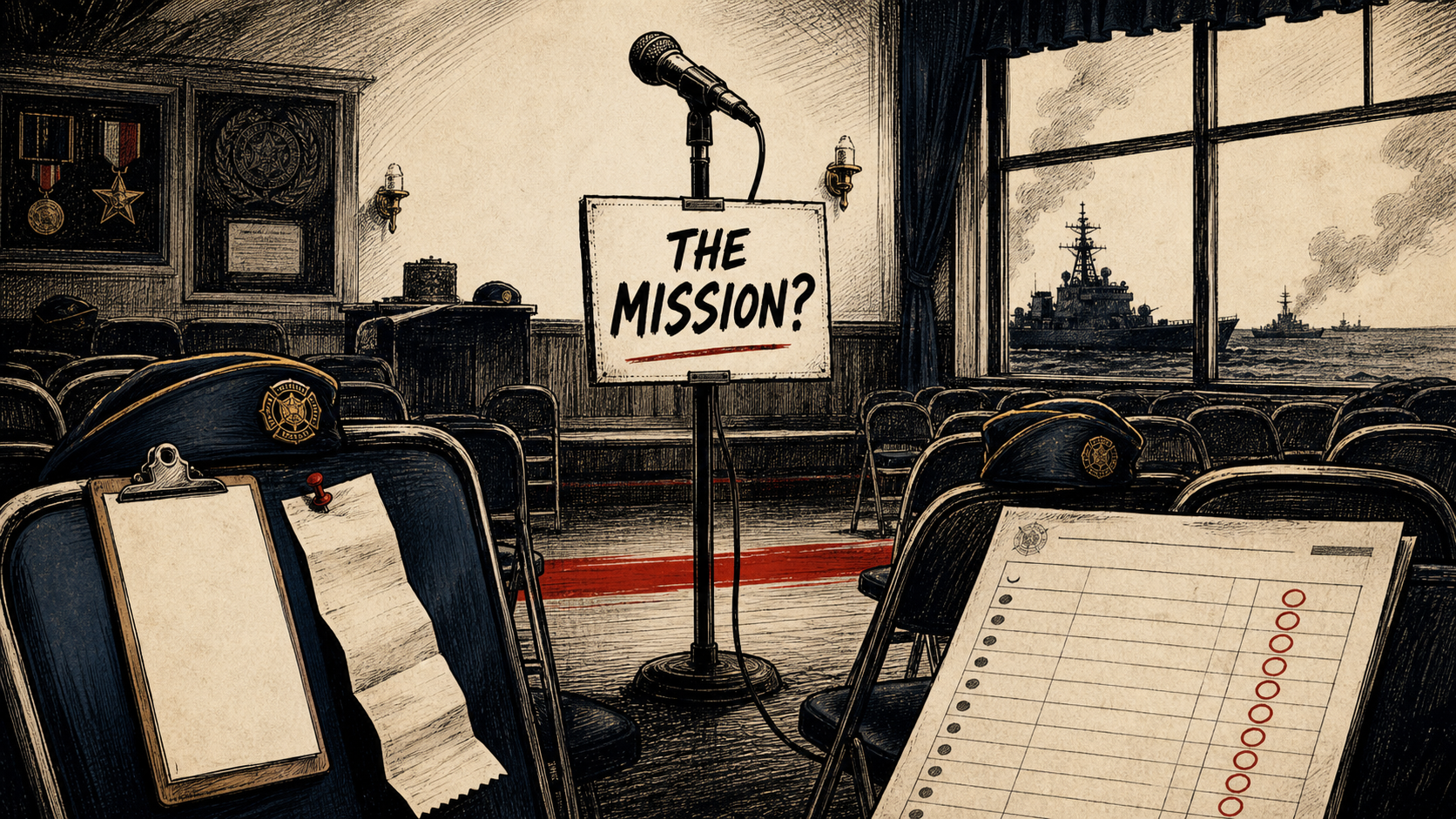
Not "is this strategically sound." Not "what is our regional posture." Not "how do we de-escalate."
What. Is. The. Mission.
A clock blocker owes the answer in a folding chair, on a Saturday, with the cameras on.
Friendly Fire
There is one Democratic clock blocker. His name is John Fetterman.
Not Manchin. Not Sinema. Both of them have left the building. Fetterman did this alone.
He sells himself as the regular guy. The hoodie. The shorts. The mayor of Braddock who came to Washington to be the working-class senator. Fine. Then let's talk about the working class.
Pennsylvania has roughly 800,000 veterans. A National Guard with people downrange right now. The Philadelphia Naval Shipyard. The Erie supply chain that builds for the Army. Union halls in every county where somebody's kid is two deployments deep.
Every one of them just got a senator who voted to keep their representatives from asking what the mission is.
He should sit in a folding chair this month. In Erie. In Scranton. In Harrisburg. With the cameras on. And he should answer one question.
Senator, do you believe a president can pause a sixty-day clock by sending a letter that says "terminated"?
Yes or no.
Not a paragraph. Not a vibe. Not a thumbs-up emoji. One word.
If the answer is yes, say it on camera and let the working class he keeps invoking decide what they think of it.
If the answer is no, vote like it the next time.
A senator does not get to brand himself the working-class senator and then take the working class to a war they cannot ask their own Congress about.
That is not authenticity. That is cosplay with a voting card.
The Line To Steal
They did not end the war. They tried to end the clock.
Once the clock becomes negotiable, the vote becomes optional.
Once the vote becomes optional, every campaign in 2026 has one job.
Name the clock blockers. Take it back to the room.
Sources
- AP on Trump's May 1 letter and the War Powers deadline.
- Defense News on Hegseth's ceasefire-clock theory.
- Senate Periodical Press Gallery on the 47-50 vote.
- CBS News on Collins, Paul, and Fetterman.
- Iran International on the roll-call context.
- AP on ceasefire negotiations.
- Axios on Trump's renewed-strike warning.
- AP on the Pentagon's public cost estimate.
- NOTUS on defense-contractor campaign contributions and congressional defense spending.
May The Bridges We Burn Light Our Path Forward.