
| Washington, D.C. | Monday, May 18, 2026 |
Voting Rights · The Network
BURN THE PLAYBOOK
Issue #34 · Part 2 of 2 · May 18, 2026
They're Not Rewriting History. They're Replaying It.
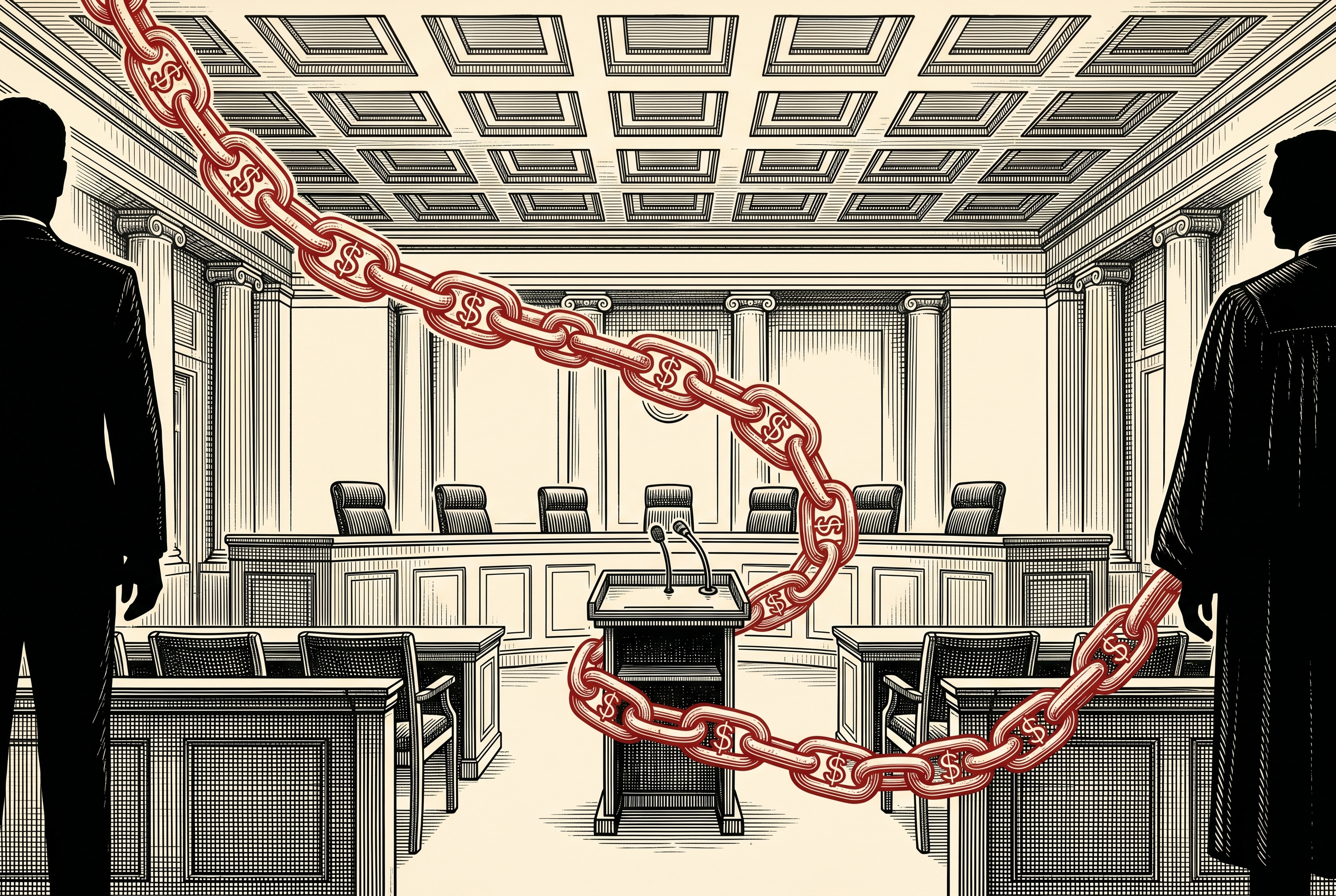
One lawyer. One map-drawing machine. One $1.6 billion judicial pipeline. One gutted Justice Department. The architecture behind the ruling that ended Section 2.
The Sentence
This is the coup after the coup.
Open The $1.6 Billion Receipt Read The Companion InvestigationIf You Missed Part 1
A Jan 6 attendee who publicly defends a convicted voting-machine breacher is the lead-named plaintiff in Louisiana v. Callais — the 6-3 Supreme Court ruling that gutted Section 2 of the Voting Rights Act on April 29, 2026. A co-plaintiff, age 78, told the New York Times he did not know his name was on the case. The other ten plaintiffs have, per the Times, "limited public profile." Catch up: Part 1 — The Ruling.
Twelve people in Brusly, Louisiana did not wake up one morning and decide to undo the Voting Rights Act at the Supreme Court.
This is who did.
★ Companion Long-Form InvestigationWho Paid To End The Voting Rights ActA two-year investigation. Twelve plaintiffs. Five lawyers. Nine amici. One funder coalition. One gutted Justice Department. One ruling that ended Section 2 of the Voting Rights Act.Read The Full Investigation →The Network's Lawyers
The clock is running backward — and it has been running for thirteen years. The lawyers did not arrive at the Court by accident. Two of them are worth saying out loud.
Paul Loy Hurd is a Monroe, Louisiana attorney. He has been in private practice since 1990, "primarily dealing with constitutional election redistricting." He organized the Callais v. Landry lawsuit. He recruited the plaintiffs.
He testified before Louisiana state lawmakers opposing SB8 on January 18, 2024, ten days before the suit was filed. He has been litigating Louisiana redistricting since at least Hays v. State of Louisiana in 1994.
Thirty-six years.
Edward D. Greim, partner at Graves Garrett Greim LLC of Kansas City, Missouri, argued the case twice before the Supreme Court — March 24, 2025, and at the reargument the Court ordered for October 15, 2025. He is a listed Federalist Society contributor. He is a Republican National Lawyers Association member. He has filed Supreme Court amicus briefs on behalf of the National Republican Redistricting Trust — including in Rucho v. Common Cause.
His federal-court docket is the conservative legal-foundation network's docket: NorCal Tea Party Patriots v. IRS (2013), the Bradley-funded John K. MacIver Institute (2016), Wisconsin Speaker Robin Vos v. the House January 6 Select Committee (2022), Voter Reference Foundation v. Balderas in New Mexico (2022) and v. Schmidt in Pennsylvania (2024) — the Cleta Mitchell voter-roll project — and now Callais.
He is not a lawyer who happened to draw a redistricting case. He is the network's lawyer. |
They put him at the Supreme Court lectern to finish the Voting Rights Act. The network has names. It always does.
The Man Who Draws The Maps
The architect of the post-Callais map cascade is Adam Kincaid. He is executive director of three vehicles at once:
Vehicle 1: The National Republican Redistricting Trust (NRRT) — organized as a legal trust, donors not disclosed.
Vehicle 2: Fair Lines America (FLA) — a 501(c)(4), donors not disclosed.
Vehicle 3: The American Redistricting Project — formerly Fair Lines America Foundation — a 501(c)(3), donors not disclosed.
All three: Kincaid is in charge. All three: dark money. Documented major contributors to the Kincaid network include the Lynde and Harry Bradley Foundation, DonorsTrust, and the multi-millionaire Art Pope.
What does the architect's portfolio look like?
Texas: Kincaid drew Texas's 2021 congressional maps. He testified in defense of them in the October 2025 federal trial alleging racial targeting.
Tarrant County: In 2025 he was hired by Tarrant County, Texas to redraw local commissioner precincts. He submitted seven drafts. Every one of them packed Black and Latino voters into a single district so white-Republican majorities controlled the others.
Indiana: He worked with Indiana lawmakers on the post-Callais congressional redraw, under documented Trump-administration pressure.
Tennessee: Tennessee redrew Memphis out of a congressional district within ten days of Callais. The Tennessee committee transcripts are already exhibits in Hale v. Lee in the Middle District of Tennessee, where federal plaintiffs are suing to stop the new map from taking effect.
This is what the architecture looks like in motion. One man's organizations draw the maps. The legislatures pass them. Local plaintiffs are recruited — sometimes by direct mail to 78-year-olds who never knew their name was on a case caption — to sue under the very Section 2 the maps were supposed to comply with. The network's lawyers carry the cases. The legal foundations file the amicus briefs. The justices, confirmed by the same network, rule the right way.
One Funder Coalition
The amici filers on Louisiana's side in Callais were the same conservative legal foundations who have spent fifty years suing for exactly this: the Project on Fair Representation (Edward Blum), America First Legal Foundation (Stephen Miller), Public Interest Legal Foundation (J. Christian Adams), Pacific Legal Foundation, Landmark Legal Foundation, Center for Election Confidence (Cleta Mitchell), Judicial Watch, plus the National Republican Congressional Committee.
These are not nine independent organizations writing nine similar briefs. Walk the money:
DonorsTrust → America First Legal: In 2024 alone, DonorsTrust gave America First Legal $21.3 million — up from $3.2 million in 2023.
Bradley Impact Fund: Bradley Impact shares five of eight board seats with the Bradley Foundation; Bradley funds DonorsTrust as a $1M+ contributor; Bradley Impact gave PILF $300,000+ across two recent tax years.
The Edward Blum vehicle: The Project on Fair Representation, behind Shelby County v. Holder (2013), SFFA v. Harvard (2023), and now the Callais amicus in 2026, was fully financed by DonorsTrust from 2006 to 2011 and continues to take direct DonorsTrust + Searle Freedom Trust + Bader Family Foundation grants.
The same handful of family foundations and donor-advised funds (Bradley, DonorsTrust, Searle, Olin, DeVos) sit on each other's boards AND fund POFR + AFL + PILF.
Same checks. Different masks. |
The thirteen-year arc reads in one breath. Same funders. Three landmark wins. Section 5 of the Voting Rights Act (2013). Race-conscious admissions (2023). Section 2 of the Voting Rights Act (2026). A campaign.
The Justices Weren't Delivered By Accident
Someone, reasonably, will ask how six Supreme Court justices end up on the same side of the same opinion against the same Voting Rights Act in a country where the VRA passed the Senate by an overwhelming bipartisan margin in 1965.
His name is Leonard Leo. He is the co-chairman of the Federalist Society. He personally ran the confirmation campaigns of John Roberts, Samuel Alito, Neil Gorsuch, Brett Kavanaugh, and Amy Coney Barrett. He helped seat Clarence Thomas in 1991. As legal journalist Jeffrey Toobin put it, Leo is "responsible, to a considerable extent, for one third of the justices on the Supreme Court."
That is every Republican-appointed justice in the Callais 6-3 majority. Leo built the court that ended Section 2.
In 2021 a single conservative megadonor — Barre Seid — gave Leo an unprecedented $1.6 billion to direct. Leo launders that money through The 85 Fund, the Concord Fund, and a constellation of LLCs and trusts to candidates, judicial campaigns, "issue advocacy" groups, and the legal-foundation network we have just been naming. The Senate's own investigation, led by Senator Sheldon Whitehouse, has documented at least $580 million in court-capture spending since 2014.
So when six justices vote 6-3 to gut Section 2 in Louisiana v. Callais, it is true to say five of them owe their seats to Leonard Leo's machine — and that machine was funded by the same money that funded the amici and that captures the campaigns of the state Attorneys General who joined Louisiana as friend-of-the-court.
That is the side of the ledger that came to court. The other side did not show up.
The DOJ That Wasn't There
The Voting Rights Act came to the Supreme Court without a lawyer. That is not a metaphor.
Inside the United States Department of Justice, the Civil Rights Division has been gutted. Between Trump's second inauguration on January 20, 2025 and the end of May, 250 attorneys (70 percent of the entire Division) resigned or were forced out. The Voting Section specifically went from about 30 career attorneys to three. The career chief was reassigned. Six managers were reassigned. One manager retired. Career attorneys were directed to dismiss the pending Section 2 cases the Division had previously been litigating — and they did. Harmeet Dhillon, the new Civil Rights Division head, was confirmed by the Senate in April 2025.
When Callais was reargued on October 15, 2025, the Trump DOJ filed an amicus brief on the side of the State of Louisiana. The Principal Deputy Solicitor General Hashim Mooppan argued that position before the Court. The United States, which under the Biden DOJ had defended Section 2 enforcement, switched sides.
The Court did not have to engineer the flip. By the time of reargument, there were no career federal lawyers left inside the Justice Department to defend Section 2 from the inside.
The Voting Rights Act came to the Supreme Court in October 2025 without a lawyer. |
One Story Wearing A Cleaner Suit
A Jan 6 attendee defending a convicted election-machine breacher is the lead plaintiff in the case that ended Section 2. The lawyer arguing his case has spent thirteen years moving from Tea Party IRS cases to Wisconsin Speaker Vos's January 6 subpoena fight to a SCOTUS lectern. The architect of the maps that produced the case runs three dark-money vehicles funded by Bradley and DonorsTrust and Art Pope. The amici on his side are funded by the same names. The justices were confirmed by Leonard Leo. The Civil Rights Division that would have argued the other side no longer exists.
Charlottesville was not a glitch. January 6 was not a one-off. Voter suppression is not paperwork. It is one story wearing a cleaner suit.
The shapes change. The actors change. The story does not. Every time this country has tried to expand its democracy, somebody has shown up with a flag, a robe, a loophole, and a lie. The flag in 1865 was Confederate. The flag in 2017 was Confederate. The flag carried into the Capitol on January 6, 2021 was Confederate. The flag in the editorial cartoon we published with Part 1 is Confederate — and it is being held aloft by Supreme Court justices.
They know exactly what they're doing. |
The Coup After The Coup
This is the coup after the coup. No tanks. No dramatic explosion. There is a court ruling on April 29 and a Virginia court ruling two weeks later and a Tennessee map redrawn in ten days and federal lawsuits filed within two weeks more — Hale v. Lee, Sherman v. Lee, I AM Foundation v. State of Tennessee — and a Justice Department that cannot answer the phone because 70 percent of its civil-rights attorneys have walked out. There is gerrymandering and purges and intimidation and a thousand procedural cuts, each one survivable, all of them together not.
The strategy is not new. The names on the Bradley letterhead are different from the names on the White Citizens' Council letterhead. The case captions are different. The amicus stacks are different. The funding has been laundered through more LLCs and trusts and donor-advised funds. The Court's reasoning is more polite. The endpoint is identical: districts where Black voters cannot elect candidates of their choice, in a country where they fought and bled to acquire that right inside the lifetimes of people still alive.

Vote Like They're Trying To Stop You
There is no constitutional ladder out of this. The ladder is gone. The Court that would have sustained the ladder is the Court that sawed it off. The DOJ that would have rebuilt it is empty.
What is left is organizing, lawyering at the state and municipal level, building media that names the network out loud, and turning out the coalition the Court is afraid of in numbers it cannot redistrict around. Tennessee's plaintiffs in Hale v. Lee are a Black pastor named Earle Fisher, a voter named Vicki Hale, Stephen Cohn, Chaney Mosley, Amber Sherman in the consolidated Sherman v. Lee, and several more. The Memphis-eliminating map's drafters are about to be deposed. Their own committee transcripts are exhibits already.
That is one map. Tennessee's. There are forty-nine other states.
If you are in Louisiana, the people who carried Robinson v. Ardoin — Press Robinson, the Power Coalition for Equity and Justice, the NAACP Louisiana State Conference — they need lawyers, money, and signal boost as they litigate the next round. If you are in Tennessee, the Memphis pastor named in Hale v. Lee is the door. If you are in Virginia, the coalition that won the redistricting amendment and just had it taken from them is the door. If you are in Texas — Adam Kincaid's home base of operations — there is a federal redistricting trial that has been waiting nine months for a ruling and could be appealed to this same Supreme Court at any time.
Vote like they're trying to stop you. Because they are.
The Reader Assignment
No Ads. No Sponsors. No Softening.
We do not run ads in this newsletter. We will not soften a sentence in this letter for a sponsor or a foundation or a friend. That is the contract.
What we ask:
Forward this to one person who has not subscribed. That is how Beehiiv's algorithm believes we are real.
Read Part 1 if you missed it: same archive, one day back.
Copy this anywhere — X, Bluesky, LinkedIn, group chat: "The Voting Rights Act came to the Supreme Court without a lawyer. — Burn the Playbook."
Subscribe Free By Magic LinkThe Work That Needs Doing
Real linkable openings at insurgent accountability orgs. No DCCC/DSCC/DLCC.
Brennan Center for Justice. Voting Rights & Elections team — the amicus and policy bench that names the network.
Open Brennan careers →Campaign Legal Center. Voting rights and redistricting litigation.
Open CLC careers →Democracy Docket. The journalism that surfaces the Bert Callaises of the world before they get to the Court.
Open Democracy Docket jobs →CREW (Citizens for Responsibility and Ethics in Washington). The investigators tracking Leonard Leo's $1.6 billion.
Open CREW careers →OpenSecrets. Public-records and journalism roles supporting the Whitehouse-led court-capture investigations.
Open OpenSecrets careers →Public Defender — Louisiana, Tennessee, Virginia, any redistricting-fight state. The franchise fight runs through the criminal-legal system in parallel.
Open Govjobs →The Verdict
Yesterday was the human face on the case. Today is the architecture. One lawyer the network calls when it needs a lectern. One man with three dark-money vehicles drawing the maps. One funder coalition wearing nine masks. One operator with $1.6 billion. One Justice Department too gutted to send a lawyer to argue the other side.
This is not three coincidences. This is not even one ruling. This is a thirteen-year campaign that just finished its third landmark win.
Name the network out loud. Then organize against it like the Court is not coming to save you. Because the Court is the network.
May the bridges we burn light our paths forward.
— Michael Starr Hopkins · Burn the Playbook, Issue #34 · Part 2 of 2 · May 18, 2026 · If you got here without reading Part 1, start there — it is the human face on the case. Part 2 is the machine.
Magic Link
If someone forwarded you this issue, skip the signup maze and join BTP here:
Forwarded this? Burn the Playbook. Subscribe By Magic Link |